Demand, pricing and supply signals are already there. The step is letting AI agents act on them, within the rules merchandising and supply teams set, with a record of what they did.
Book a Data & AI Readiness Assessmentof retailers can't join their customer, product, and inventory data into a single decision-ready view.
Retail has spent a decade buying point solutions — CDPs, ESPs, demand-forecasting tools, loyalty platforms, BI suites. Each one promised to be the source of truth. None of them are.
The result: merchants make markdown decisions from gut, marketing optimises a channel without seeing margin, and the board hears another quarter of "we're investing in data and AI" without a concrete answer to what it's returning.
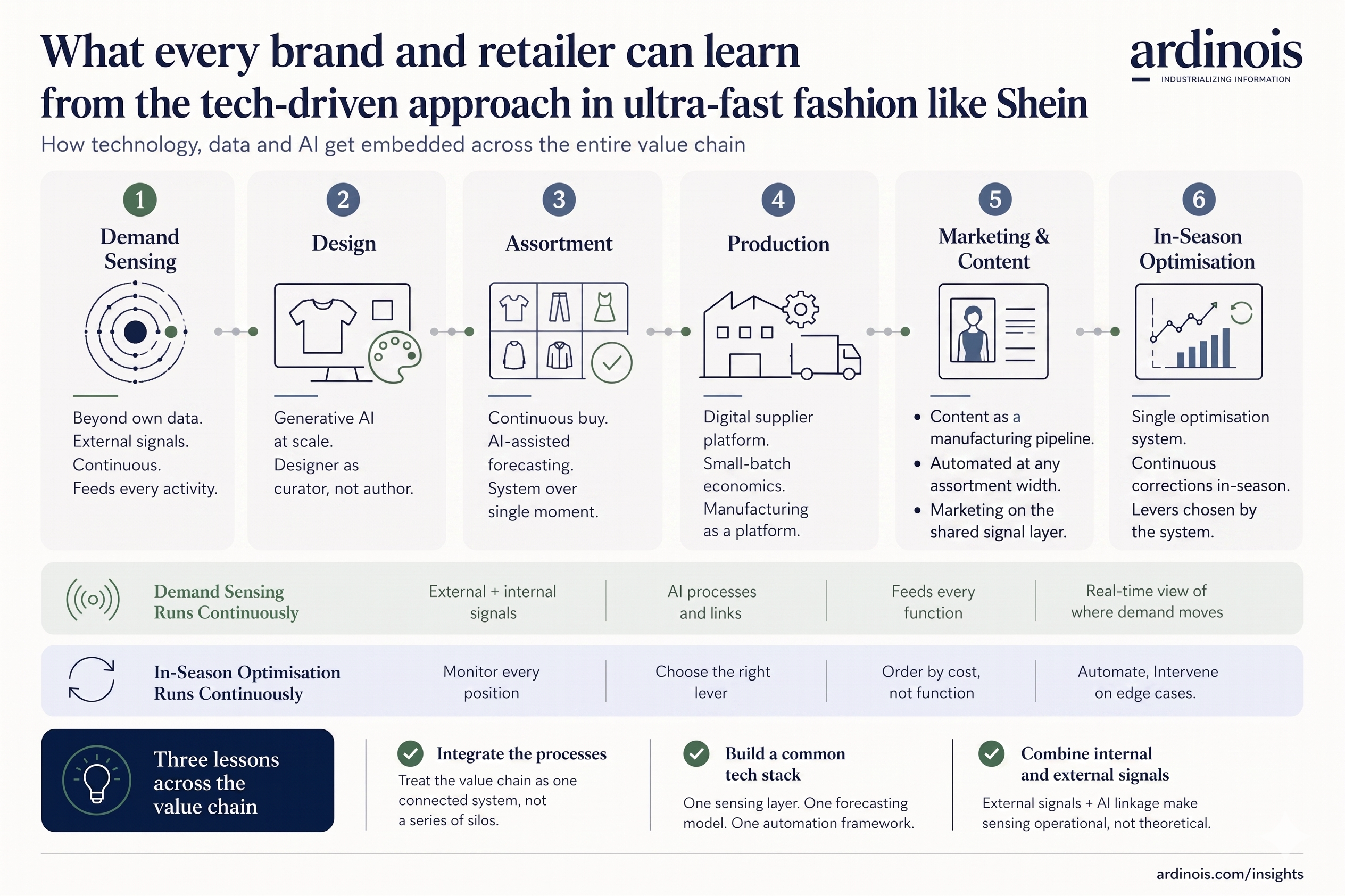
The unlock isn't a single heroic use case — it's AI woven across the chain, fed by signals from beyond your own four walls, and tuned continuously rather than once a season.
Pricing, allocation, and content tuned continuously — not on a quarterly calendar. The signal from every stage feeds every other.
Design variations and the marketing long tail produced at near-zero marginal cost. Hero work stays human; the rest scales.
One forecast joined across sensing, assortment, and production — not three different versions arguing in a meeting.
Customer, product, inventory, and supplier mean the same thing across every system that touches them. The unlock isn't another integration project — it's a shared semantics layer that lets AI work across the chain instead of inside each silo.
Use cases we see deliver measurable margin or efficiency within two to three quarters.
SKU-store-week forecasts that beat the planner's gut and the vendor template — feeding allocation, replenishment, and open-to-buy.
Price and markdown decisions that respect competitive position, inventory health, and brand guardrails — at scale.
Trigger-based journeys built on a real customer graph — not a list export from yesterday's CDP.
Cluster-level assortment and planogram decisions informed by sell-through, basket affinity, and local demand signals.
Three phases, one architecture. Each phase produces something the next stands on, and each ends with a decision the organisation can take without us.
The gaps between the assistants in place and the work that could be handed over.
Foundational architecture, decision register, platform requirement and selection where needed.
Governance, components and builder teams until each element has an owner inside.
A warehouse is a foundation, not a strategy. A readiness assessment tells you whether that foundation supports the AI decisions your board is asking for — and where the gaps are between today's BI cadence and a decisioning operating model.
We don't sell implementation hours or software. The assessment is a fixed-scope, fixed-fee diagnostic delivered by partners — not a junior team building toward an upsell.
Yes. We're vendor-independent. We assess your current estate as-is and recommend the smallest viable change to get you to your target posture.
The assessment delivers a usable roadmap in 4–6 weeks. The first pilot typically goes live within two quarters. Measurable business impact tracks the pilot's success metrics.
30 minutes. Tailored to retail. No pitch deck, no obligation.