
Part 2 of 4 — AI Transformation: From Ambition to Impact
One of the questions I get most often is some version of: “What is the AI use case that is driving the most value in enterprises right now?”
It is a reasonable question, and the honest answer is that there is no single one. The use cases that create the most value depend heavily on the type of organisation, its business processes, its strategy, and the technology landscape it is already working with. A use case that transforms operations in a global retailer may be largely irrelevant to a financial services firm.
What does generalise, however, is the approach to building a portfolio — one that delivers results in the near term, builds the right foundations, and positions the organisation for what becomes possible further out. This post is about that approach.
Understanding how AI drives value
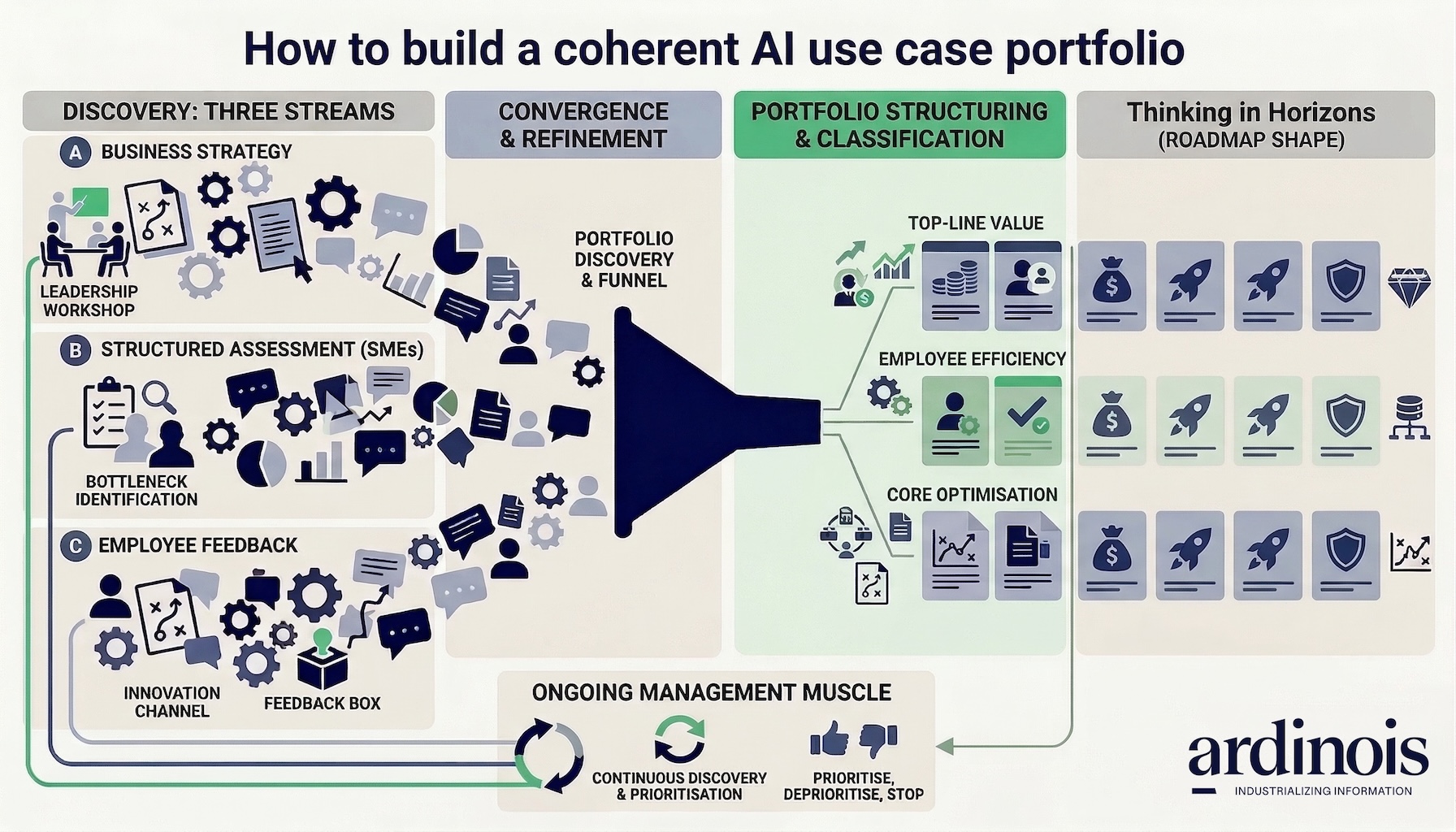
Firstly, it is important to reflect on how AI actually creates value. Because the way you measure success, and the business priorities you are optimising for, will differ depending on which category you are working in.
There are broadly three:
Top-line value: increasing revenue, improving conversion, unlocking new business models or customer experiences. This often requires bespoke solutions and has larger cycle time.
Employee efficiency — automation and agentic workflows that reduce the time people spend on repetitive or low-value tasks. This is increasingly where generative AI is making an early impact, and the ROI is often relatively quick to demonstrate. The key is here not to focus on one single use-case rather build the ecosystem of capabilities that will allow repetition across the business.
Core business process optimisation — improving the efficiency and accuracy of the organisation’s fundamental operations: demand forecasting, supply chain, pricing, risk modelling. This is largely the domain of traditional machine learning, and often where lots of durable value sits in large enterprises.
The distinction matters for portfolio management because these categories have different measurement approaches, different time horizons, tech implementations and represent different strategic choices. An organisation focused on margin improvement will prioritise differently than one focused on revenue growth. Being explicit about where the dial is set, and making that a conscious leadership decision rather than an implicit one.
Three ways to uncover the right use cases
Figuring out what to start, continue and stop are the key decisions in portfolio management. To make the right decisions, the funnel needs to be filled. We see 3 distinct channels that will surface the most impactful use-cases effectively.
Starting with business strategy. The most valuable AI use cases are usually not found by asking “what can AI do?” They emerge from asking “what are we trying to achieve, and where might AI help us get there faster or better?” This requires bringing AI expertise into direct conversation with business leaders — through workshops, structured sessions, or embedded collaboration. Over time, the goal is for business leaders to develop enough AI literacy to bring those insights proactively, without needing a facilitator to broker the conversation every time.
Structured assessment with subject matter experts. When the goal is core process optimisation, the people who know the most about where value is being lost are usually the people closest to the process. Structured assessments with operations, supply chain, finance, or commercial teams tend to surface the most significant bottlenecks — and those are often where AI can have the most durable impact. These individuals understand the constraints, the data, and the edge cases in ways that no external analysis can fully replicate.
Listening to employees. The third stream is bottom-up, and it tends to be underestimated. As an AI programme matures, employees across the organisation will begin identifying use cases from their own day-to-day work. Individually, these may not represent the highest ROI. But they often share underlying technical requirements with other cases, which means they can be addressed more efficiently as a group than in isolation. There is also something important about the people who surface these ideas: they tend to become the most effective advocates for adoption. Building a channel for these contributions — and genuinely acting on them — helps drive the overall change.
Thinking in horizons
A coherent portfolio is not just a prioritised list of use cases. It is a roadmap with a shape — one that balances near-term delivery with longer-term capability building.
In the near term, the goal is to demonstrate value clearly and build organisational confidence. These are typically use cases with relatively short development cycles, measurable outcomes, and visible impact for the teams involved. They serve the programme as much as they serve the business — they establish credibility and create momentum.
In parallel, the foundation needs to be built. The data infrastructure, integration layers, and ways of working that will make future use cases significantly cheaper and faster to deliver. This is often the least visible part of the programme to senior leadership, and the most important to protect from short-term pressure.
Further out, the portfolio should be oriented toward the use cases that become possible once the foundation is in place — the more complex, cross-functional, or transformative applications that simply cannot be built without the groundwork having been done first.
Holding all three horizons simultaneously, and being explicit about which investments serve which horizon, is one of the more important disciplines in AI portfolio management.
The portfolio is not a one-time exercise
One thing that distinguishes mature AI programmes from early-stage ones is that use case discovery and portfolio management become ongoing rather than periodic. The three streams described above do not produce a definitive list — they feed a funnel that evolves as the organisation learns, as the technology develops, and as business priorities shift.
Building the muscle to manage that funnel continuously — prioritising, deprioritising, and occasionally stopping things — is as important as the quality of the initial roadmap.
This framework is the basis of our AI Use Case Portfolio service — a structured 4–6 week engagement that produces a prioritised portfolio with scored business cases and a phased roadmap.