
Years ago Inditex revolutionised the fashion operating model. Store managers fed back daily on what was selling and what customers were asking for. Production sat close to home in Spain, Portugal, Morocco and Turkey. Initial runs got smaller. Sketch-to-store cycles collapsed from months to weeks. Replenishment was driven by sell-through, not by a forecast set a year out. The whole model ran on a tight feedback loop between stores, design, and a nearby supply chain.
Ultra-fast fashion is taking this further. A lot of the difference comes down to how technology, especially data and AI, is deeply embedded throughout their operations and across the entire value chain.
Looking at their practice brings some real insights for more traditional brands and retailers. The point isn’t to copy them. It’s to see which operating capabilities transfer, and how you’d apply them given your own position.
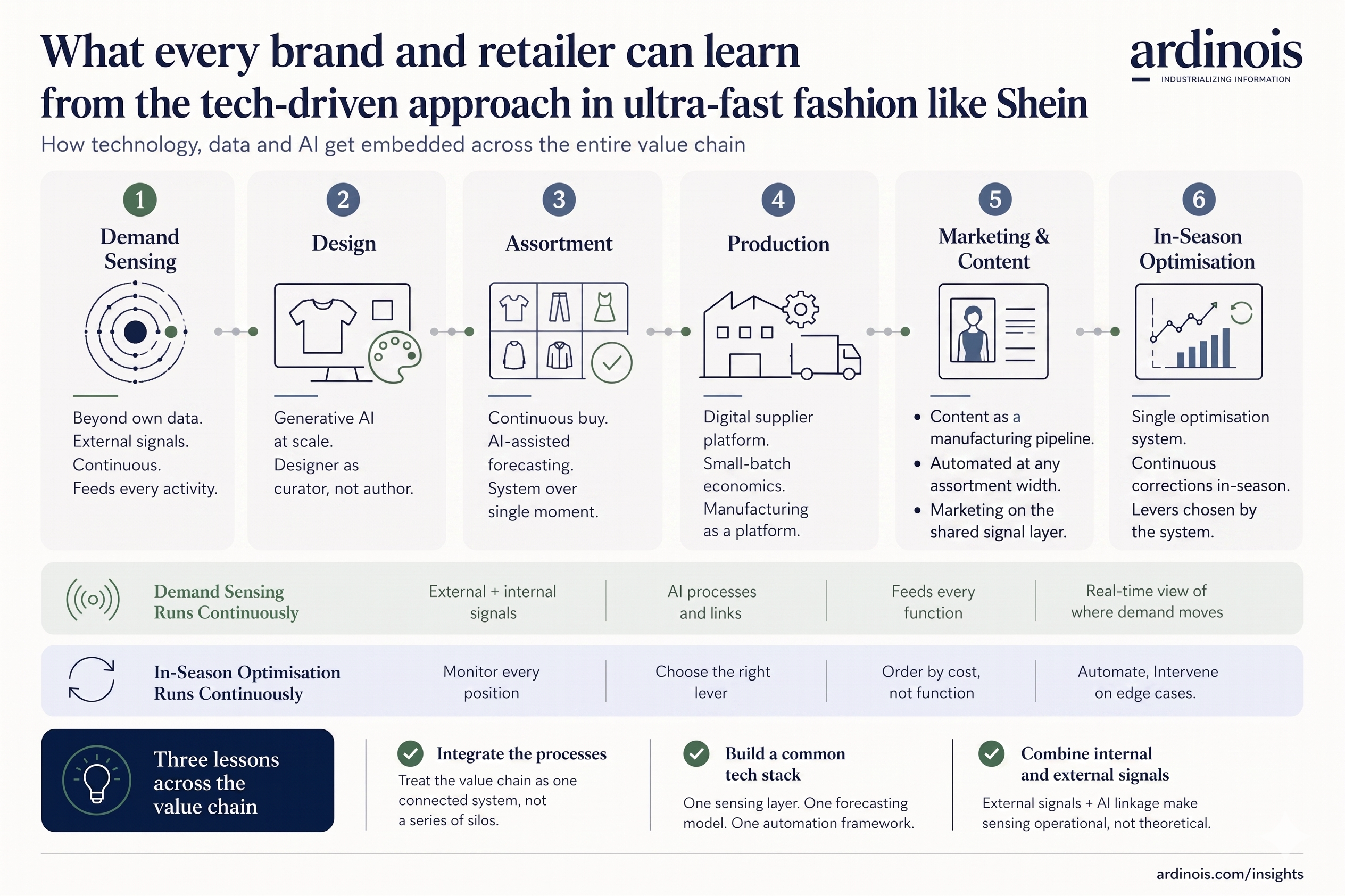
A note on the structure before we walk through: the value chain isn’t a strict sequence. Demand sensing runs continuously underneath every activity. In-season optimisation runs continuously on top of every activity. Design, assortment, production, marketing and content sit in between, happening in parallel and feeding each other rather than handing off in one direction. They’re peers, not steps.
Demand Sensing 2.0
At the core of any brand or retailer’s operation sits knowing consumer demand. Forecasting on mostly own signals at fixed points in the lifecycle is the de facto standard for planning.
Two key differences in how ultra-fast players tackle this.
They go well beyond internal signals. Traditional players run on own sales velocity, store-level performance, returns, and customer feedback. The own commercial history is the dominant input. External signals, when they exist at all, come from a trend agency once or twice a season.
Ultra-fast players operate at a different level. Competitor assortments are scraped continuously. Social platforms are monitored for emerging styles, colours, silhouettes. Search behaviour and engagement data across the wider market feed a constant view of where demand is moving. The signal isn’t just what’s selling on their own channels. It’s what’s selling, and what’s starting to sell, anywhere.
They use the signal across every activity, continuously. Even where good signals exist in traditional players, they tend to feed one function, on one cadence, for one decision: the seasonal buy. In an industrialised setup, the same signal flows into design, assortment, production, pricing, allocation, and marketing simultaneously. Continuously. One sensing layer feeding every activity.
This is the single biggest gap I see in most retailers. External sensing is rare. When it does exist, it sits in a trend or innovation team, disconnected from the buy and from everything else. Closing it is partly a tool decision. Mostly it’s an operating model decision.
Design 2.0
In a traditional brand, design is a long-cycle activity. Designers develop a vision, build a collection, present, iterate, commit. Even the fastest classical retailers still put designers in front of every design decision. The function is creative. The unit cost of a design is real.
Two key differences in how ultra-fast players approach design.
The marginal cost of a design variation approaches zero. Generative AI does serious work in producing variations on validated themes. A style that shows traction can spawn dozens of derivatives within days. Patterns, colourways, silhouettes, at a volume no human design team can match.
The whole logic of long-cycle design assumed each design was a meaningful investment. When that’s true, intentionality is rational. When variation is free, the logic flips. The constraint stops being how to produce a good design. It becomes how to choose from many.
The designer’s role shifts from author to curator. Less of the work is sketching and committing. More of it is directing a generative process, setting the boundaries within which variations get produced, and selecting from what comes out.
This cuts in opposite directions depending on where you compete. For brands competing on assortment width, design becomes a curation layer over a generative production process. For brands competing on position, scarcity gets more valuable, not less. Restraint becomes a brand asset. A premium brand that picks up the productivity gains and defaults into ship-more mode dilutes itself. The capability is transferable. The default usage pattern is not.
Assortment 2.0
Traditional assortment planning is a pre-season exercise. Buyers and merchandise planners build the buy from trend research, historical sales, brand strategy, and judgement. Quantities get committed months in advance, sometimes a full year for long-lead categories. Mix, depth, and allocation are optimised within those commitments. Forecast quality determines the margin outcome.
Two key differences in how ultra-fast players plan assortment.
The buy is continuous, not committed in a single moment. Initial commitments are smaller. The full assortment isn’t decided up front. It’s built through a series of smaller decisions, each one informed by the live signal. AI-assisted demand forecasting moves from a once-or-twice-a-season exercise to a continuous estimate. Range, depth, and cluster allocation get tuned based on what’s actually moving in the market and on the brand’s own channels.
The planner’s role shifts from prediction to system design. Less of the work is committing the buy. More of it is configuring the system, defining the rules, the constraints, the brand-level boundaries within which the algorithms operate.
The gap here in most brands isn’t software. The market for assortment optimisation tools is mature. The real gap is the planning calendar and the decision authority. Continuous assortment means giving up the comfort of a finalised pre-season buy. Most organisations aren’t structured to do that, and the discomfort is the actual barrier.
Production 2.0
The visible part of ultra-fast is the front end. The actual differentiator is the supplier model.
Two generations of supplier integration are now visible. The first generation, which Inditex set the standard for, is built on geographic proximity, modular production, and treating suppliers as integrated participants in an operational rhythm rather than transactional vendors.
Two key differences in the second generation.
The supplier model runs as a digital manufacturing platform. Suppliers see demand data, receive orders, deliver, and get paid through a continuous digital interface. Capacity is visible across the network. Pricing adjusts to demand. The commercial model looks more like a logistics platform than a brand-supplier relationship.
Small-batch economics become viable. Production runs as small as 100 to 200 units become economically reasonable. That changes the risk profile of every product decision, and turns the entire portfolio into a continuous test.
This is the part of the value chain that gets the least attention in board conversations about AI in retail, and it’s the hardest to replicate. Purchase order culture, forecast-driven contracts, supplier consolidation strategies, lead-time negotiations. All of it is optimised for a different game. The brands that have got closest to industrialised supplier integration did so by treating their supplier base as an operating system rather than a procurement category.
Finance also gets ignored in this conversation. Small-batch production with high SKU turnover changes working capital dynamics, markdown reserve modelling, and margin attribution. Most brand finance functions are built around seasonal commitment cycles. They can’t model the new shape without rebuilding their planning logic.
It rarely makes the CFO agenda. But it’s what decides whether front-end speed is commercially viable.
Marketing and Content 2.0
Every product needs imagery, video, descriptions, localised copy. At a traditional assortment width this is real work. At industrialised width it’s impossible with traditional studio workflows. The classical answer is industrial studio operations, large internal creative teams, a high-volume photography pipeline. The economics work for bounded assortments. They break for unbounded ones.
Three key differences in how ultra-fast players handle marketing and content.
Content becomes a manufacturing pipeline. Generative imagery, automated composition, on-model rendering, programmatic copy and translation make throughput at any assortment width possible. Content stops being creative production at unit cost.
The honest move for senior creative leaders is to split the portfolio. Hero content for brand-defining moments, campaigns, and franchise products stays creative work. Tail content for variant SKUs, market-specific renderings, and long-tail products is production work. Different pipelines, different quality bars, different governance, different cost structures. Most brands run both through the same studio process. Hero content gets diluted by volume. Tail content gets bottlenecked by review.
Marketing draws on the same signal layer as everything else. Campaign automation, personalisation engines, recommendation systems, dynamic ad creative, all drawing on the same signal and the same content pipeline. Marketing stops being a separate function with its own calendar and starts being another consumer of the shared system. The integration of marketing and content is one of the cleaner wins in industrialised retail, because both functions already produce digital output and both depend on the same engagement signal.
The content portfolio itself is shifting. As discovery moves into LLM-mediated surfaces, structured product data and machine-readable specifications matter more than additional lifestyle imagery. The content portfolio that performs in 2026 isn’t the one that worked in 2022. The content function isn’t just getting faster. It’s becoming a different function.
In-Season Optimisation 2.0
This is where most of the latent margin in fashion retail sits. It’s also where most of the operating dysfunction sits.
The problem is one optimisation problem. Liquidate the season’s inventory at the best possible margin, end close to zero stock. Pre-season planning gets the assortment, quantification, and allocation as close to right as it can. The forecast is never right enough for the world the products land in. The rest is corrections during the season.
In most retail organisations these corrections are made in silos. Planning manages allocation and reorders. Pricing manages markdowns. Marketing manages promotional emails and campaigns. Visual merchandising controls how products are presented. Each team optimises its own KPI. There’s no coherent view of the available levers as a portfolio.
Three key differences in how ultra-fast players run in-season.
The whole season runs as a single optimisation system. Every product position is monitored continuously. The system has visibility across the available levers and their relative cost, and decides where to apply them.
Levers are ordered by cost, not by function. A marketing email is cheaper than a markdown. Moving stock to a region where a product is selling faster is cheaper than marking it down. Restyling an existing product into a new outfit to match an emerging trend can extend its run without touching price. Markdown is the last lever, used only when the cheaper interventions don’t shift the inventory.
The operational decisions get automated. Pricing, allocation, promotion, content prioritisation. The human role sits at the system level. Setting the rules. Watching the outputs. Stepping in on edge cases. The merchandising function in most brands assumes human judgement on most decisions, with data support around the margins. The frontier operating model inverts this.
For most brands the unlock here isn’t a tool. It’s breaking the silos. Treating in-season as one optimisation problem means putting one owner on the season’s margin outcome, with visibility across allocation, pricing, marketing, content, and stock movement. Without that the levers stay siloed and the cheaper interventions stay under-used. The brand pays for it in margin every season.
Three lessons across the value chain
Three things show up in every section above.
Integrate the processes. Each activity in most retailers runs as its own silo, with its own data, calendar, and KPIs. The real margin sits in the spaces between them. Treating the value chain as one connected system, instead of a series of handoffs, is the operating model move.
Build a common, integrated tech stack. Integration isn’t just an org chart change. It needs a shared technology backbone. One sensing layer. One forecasting model. One automation framework. Tool-by-tool buying creates a fragmented stack that quietly reinforces the silos you’re trying to break.
Combine internal and external signals. Most retailers run only on their own data. That’s necessary but not enough. Continuous external signals (competitor moves, social trends, search and engagement behaviour) give a much richer view of where demand is going.
The real lift comes from how those signals get processed. Raw external feeds are mostly noise. AI is what makes sense of them and connects them back to your own assortment. A trend on social or a competitor’s pricing move only matters when AI maps it to specific SKUs, categories, or buying decisions inside your range. That linkage is where external sensing becomes operational instead of theoretical.
Once processed that way, these signals then need to flow to every function, not stay siloed in a trend team.
None of these are new ideas. What’s new is that doing all three together is now operationally viable at scale.
What this means for everyone else
The technology behind all this is becoming available. The operating model changes are well documented. Within a decade most of this will be table stakes, not differentiation.
So if the basic capability stack is going to be shared, what protects a brand? Three things matter.
Curation. Deciding what not to make. When generative AI can produce anything, a brand with strong editorial judgement becomes more valuable, not less. This needs a clear point of view and the discipline to act on it.
Vertical depth. Knowing one category deeply. A horizontal platform can do many things at scale. It can’t match a brand that has spent decades on footwear, outerwear, or denim and knows the category at a level a generalist never will.
Customer relationship. Owning the direct relationship with your customer. Loyalty, repeat purchase, feedback, lifetime value. Platforms can erode the top of the funnel. A strong direct relationship defends the bottom.
None of these are about speed. All of them are enabled by the same capabilities the ultra-fast players have built. The infrastructure that makes Shein fast also makes a curated premium brand more responsive to its core customer. The capability stack is the same. What you do with it is the strategy.
The board question isn’t whether to adopt these capabilities. It’s which version of the operating model you’re building, and which position you want to protect.
A brand that picks them up and defaults into ultra-fast usage will run out of brand equity before it runs out of inventory. A brand that picks them up and applies them to its own position will compound that position.