
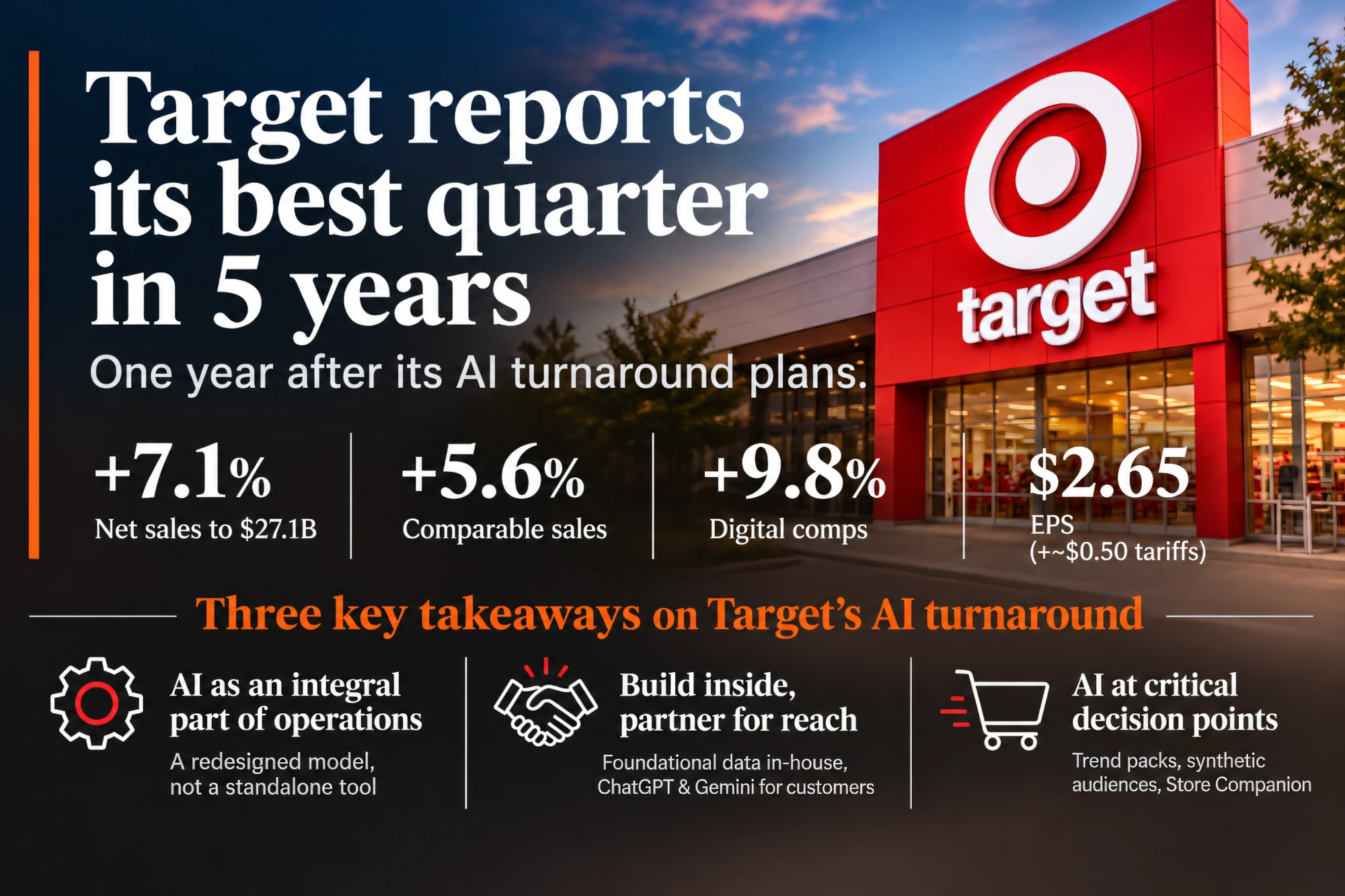
Target just reported its strongest sales growth in five years, one year after announcing its AI-backed turnaround plans. A review of how they approached AI delivery, and whether any of the financial results are attributable to the changes they made.
The setup: where Target stood in November 2025
It is worth remembering how bad things looked a year ago. Target’s comparable sales were running at −2.7%. The company had just cut roughly 1,800 headquarters roles, about 8% of its corporate workforce. A new CEO, Michael Fiddelke, was about to take over a business that had spent three years losing ground in the categories it was once famous for.
Into that context, Target announced a deal with OpenAI to build a shopping app inside ChatGPT. The timing invited skepticism, and plenty of commentators provided it. A struggling retailer partnering with the most hyped company in technology looks, from the outside, like a distraction from the fundamentals.
Twelve months later the fundamentals have turned, which makes this one of the cleaner natural experiments we have in retail AI. There is a clear before and after, the numbers are public, and management has been unusually disciplined about what it does and does not claim. That last part matters more than it sounds, and I will come back to it.
The quarter: the numbers, adjusted for the noise
The Q3 results, reported November 18: net sales up 7.1% to $27.1B, comparable sales up 5.6% with traffic up 5%, digital comps up 9.8% against store comps of 4.6%. The full-year outlook was raised from roughly 5% to roughly 6% sales growth. By sales growth, it is Target’s strongest quarter in five years.
Two adjustments before anyone gets carried away. First, EPS of $2.65 includes about $0.50 of tariff refunds, a one-off that also flatters the margin line by about 1.1 points. Excluding the refunds, adjusted EPS still grew 21%, which is the number I would anchor on. Second, the comparison base is soft: lapping a −2.7% quarter makes any recovery look steeper than it is. The two-year stack is positive but modest.
Even with both adjustments, this is a real recovery. Traffic growth of 5% is the figure that convinces me most, because traffic is hard to buy with markdowns and impossible to get from tariff refunds. People are choosing to come back.
Delivery choice 1: AI inside an operating model redesign
The first thing that stands out is sequencing. Target did not run an AI program. It ran an operating model redesign, and AI was one of the materials it was built from.
The redesign came first. The 1,800 headquarters roles were eliminated in October 2025, before the investment plan, with the stated purpose of removing management layers and speeding up decision-making. Target was explicit that this was about organizational speed rather than cost. The merchandising philosophy changed in parallel: Fiddelke’s line at the March investor day was that “Target is not an everything store,” and the apparel assortment was cut by roughly 20% of styles. Fewer categories, fewer styles, faster cycles.
Then came the money. The 2026 plan added more than $2bn of incremental investment: over $1bn in capital expenditure for roughly 30 new stores and 130 remodels, and about $1bn in operating investment that Target framed as supporting customer experience and accelerating technology adoption, alongside its investments in store payroll and training.
The order matters. Most AI initiatives I see in retail run the other way around: buy the tooling, pilot it at the edge of the organization, and hope the operating model adapts around it. It rarely does. Target removed the layers first, simplified what the merchants had to decide, and then gave them tools that made those decisions faster. The tooling landed in an organization that had been rebuilt to use it.
Delivery choice 2: building foundations inside, partnering for reach
The second choice is a clean build-versus-partner split, drawn along the right line: where the proprietary data lives.
The foundational work stayed in-house. Trend Brain is a generative AI platform that reads social, cultural, color and material signals and turns them into trend packs for merchants, so trend scouting runs on a continuous cadence rather than a quarterly one. A synthetic-audience engine simulates guest reactions to designs, campaigns, price points and pack sizes before Target commits to large buys. Ask Target, the in-app assistant, sits on Target’s own catalog and guest data. Store Companion, a chatbot for store teams, has been running since 2024. None of this is outsourced, because all of it depends on data nobody else has.
Reach went through partners. The Target app inside ChatGPT, live in beta since Thanksgiving week 2025, was among the first retailer integrations with real checkout, fresh food and drive-up fulfillment rather than a product feed. Target also joined one of the first ChatGPT advertising pilots, which is a quieter but equally interesting move: it treats the assistant as a retail media channel, not just a storefront. On the Q3 call, Fiddelke named Gemini and Copilot as the next surfaces.
The logic is sound in both directions. Nobody builds their own consumer assistant into a habit people already have, so you rent the reach. And nobody should hand their merchandising signal to a platform that sits between them and every competitor, so you keep the foundations. I see companies get this split wrong in both directions: building chat interfaces nobody visits, while piping their first-party data through a partner’s black box.
Delivery choice 3: AI at critical decision points
The third choice is about placement. Target put AI where decisions get made, not where reports get read.
The pattern repeats across the organization. Trend packs land where merchants make assortment calls. Synthetic audiences run before buy commitments, which is the moment in the merchandising cycle where a wrong call becomes expensive inventory. Store Companion sits with store teams during their shift, not in a back-office analytics suite. On the shopper side, the 2026 feature cadence followed the same logic: Review Insights summarizes reviews at the point of consideration, Photo Search removes the vocabulary problem from discovery, Buy Again shortens the path for repeat purchases.
Contrast that with the default mode of retail AI, which is to generate insight and leave the last mile to the organization. Dashboards describe the business; they rarely change a buy. The question I ask clients is not “where could AI add insight” but “which decisions, made by whom, at what moment, should get better.” Target’s deployment reads like someone asked exactly that question, function by function.
It also explains why the organizational work in choice 1 was a precondition. A trend signal that arrives weekly is worthless to a merchant organization that decides quarterly through three approval layers. Speeding up the signal only pays once the decision cycle has been sped up to match.
Attribution: what the numbers do and don’t support
So how much of the quarter belongs to AI? Less than the headline suggests, and more than zero. Direct attribution is genuinely hard here, because the AI work shipped alongside assortment resets, roughly 2,000 price cuts, 32 new stores and 130 remodels. Management itself credits those, not the AI, which I take as a point in their favor. Companies that overclaim on AI in earnings calls usually have nothing else to show.
What the numbers do support: the digital business is growing at twice the rate of stores (+9.8% against +4.6%), and nearly all of the customer-facing AI lives in digital. Fun 101, the rapid-test assortment that the trend tooling directly feeds, grew about 27%. On the Q3 call, management said the Ask Target assistant converts at roughly twice the rate of other channels, which, if it holds up, is the single most concrete AI number Target has given.
What the numbers do not support: calling this an AI turnaround. The margin expansion is heavily flattered by tariff refunds. The sales recovery leans on categories where the fix was merchandising judgment and price, not algorithms.
And one result points the other way, at least for now. Apparel and accessories are still down about 4%, and apparel is precisely the category Trend Brain was built to fix. I would not read that as failure yet. Fashion lead times are long, and an assortment influenced by better trend signals in mid-2026 does not hit shelves until spring 2027 at the earliest. It is reasonable to expect the merchandising AI to show up a season or two behind the customer-facing AI. But it does mean the most strategically important part of Target’s AI bet is the part that remains unproven.
The honest scorecard: partial attribution for the digital acceleration, no attribution for the headline quarter, verdict pending on the merchant tooling.
What I take from this
What aligns with my thinking, and where I see it go wrong most often, is the integrated redesign. AI doesn’t drive value by itself. But capabilities deployed well allow you to redesign how the business operates more effectively, and that is what shows up in both top- and bottom-line results.
Target’s case adds a useful precision to that argument: the value came from the sequence, not just the combination. Simplify the operating model, place the capabilities at decision points, rent reach where you have no advantage and build where your data is the advantage. Any one of those alone is unremarkable. Together, in that order, they turned a declining retailer’s trajectory in four quarters. Or at least, they were present while it turned, which is as much as the evidence allows.
For mid-size retailers and brands the lesson scales down well, and arguably matters more. You do not need Target’s $2bn. Reformation, at one-thirtieth of Target’s revenue, credited an AI planning engine for in-stock rates and full-price selling in the same earnings season, built on the same pattern: existing merchandising model, AI at the recut decision, no standalone AI program. The budget is not the determining variable. The willingness to change how decisions get made is.
The part to watch through 2027 is the merchant tooling. If apparel turns as the lead times unwind, Target will have demonstrated AI value in the hardest place retail has to offer: taste. If it does not, the case becomes a cleaner but smaller story about digital experience. Either way, the delivery model is the thing worth copying now.
Sources and notes
Figures come from Target’s Q3 press release (Nov 18, 2026), the Q3 earnings call transcript, AP/StockAnalysis coverage of the quarter, Target’s 2026 growth strategy and investor-day coverage by CIO Dive and Motley Fool, the OpenAI deal coverage (Nov 2025), Digital Commerce 360 on Target’s agentic commerce stance and Retail Dive on the 2026 AI feature releases. Reformation figures are from its Q3 2026 earnings call.