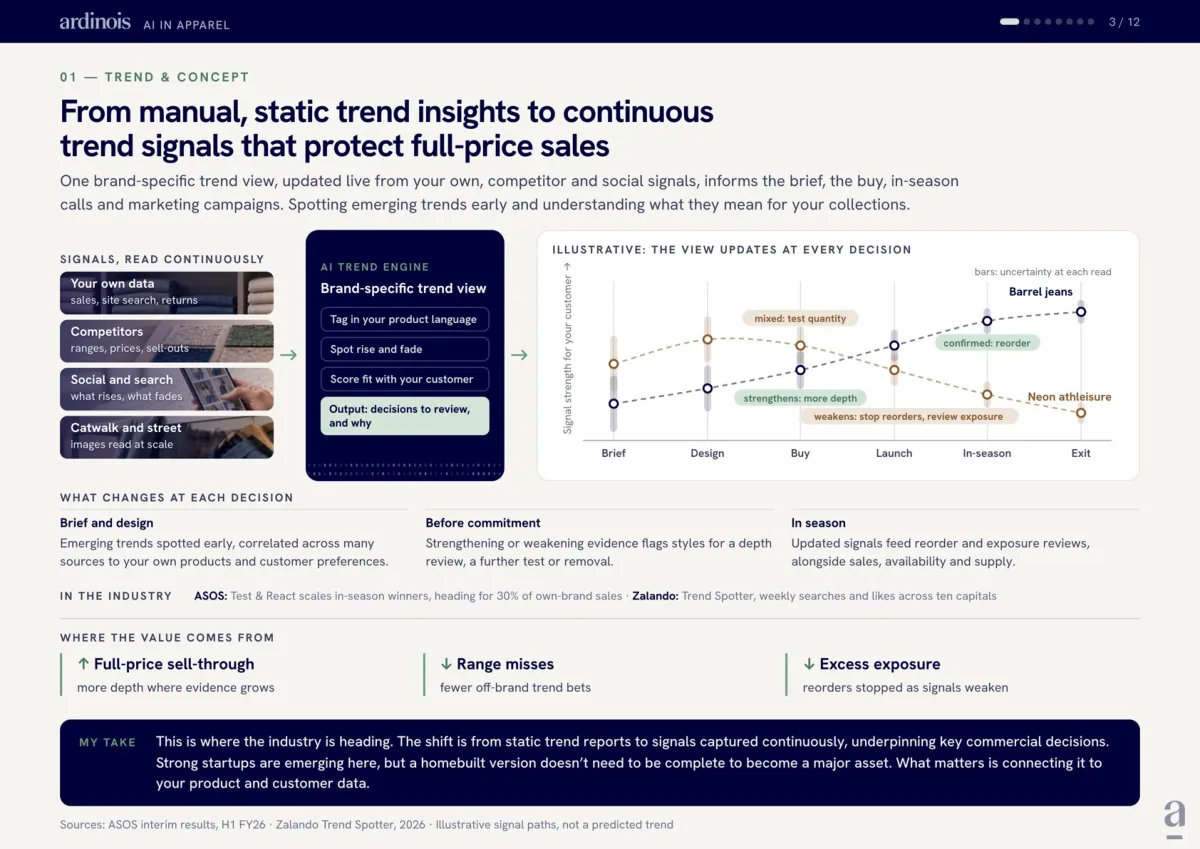
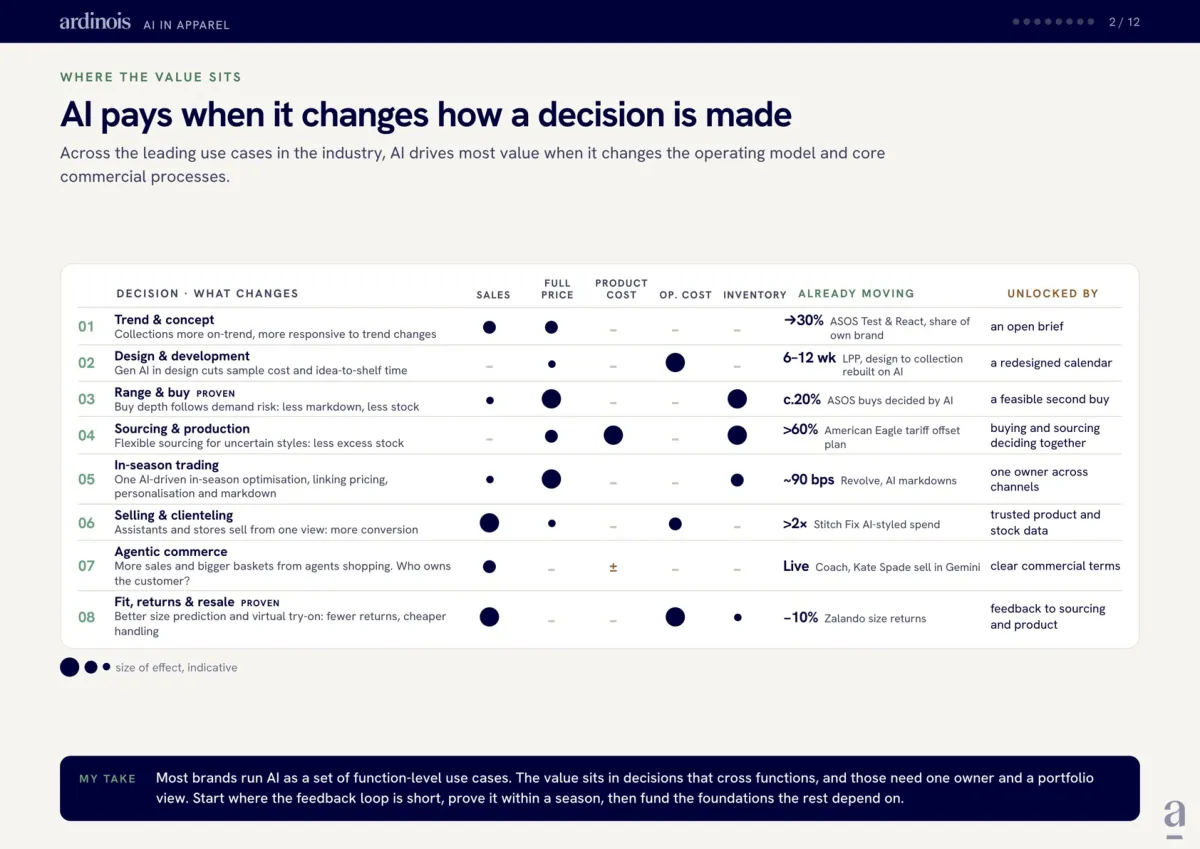
01 Trend & concept
Collections more on-trend, more responsive to trend changes.
Already moving
ASOS Test & React buys small, then scales the in-season winners. It is heading for 30% of own-brand sales. Zalando Trend Spotter reads weekly searches and likes across ten capitals.
Source: ASOS interim results, H1 FY26; Zalando Trend Spotter, 2026
02 Design & development
Gen AI in design cuts sample cost and idea-to-shelf time.
Already moving
LPP takes design to collection in 6–12 weeks, down from 6–12 months, after rebuilding the process around AI. Walmart goes from trend to product in 6–8 weeks with gen AI, from about six months.
Source: LPP investor day via Reuters, May 2026; Walmart Corporate, Apr 2025
03 Range & buy
Buy depth follows demand risk: less markdown, less stock.
Already moving
About 20% of buying decisions at ASOS are now made by AI, as part of a wider rework of how it buys.
Source: ASOS interim results, H1 FY26
04 Sourcing & production
Flexible sourcing for uncertain styles: less excess stock.
Already moving
American Eagle uses AI simulations, alongside pricing, supplier talks and freight, in its plan to offset more than 60% of its tariff cost. Half of US brands now use AI for sourcing strategy and cost, according to a 2026 industry survey. The decision is getting bigger: Gap has cut China to under 3% of sourcing, and Inditex makes over half of its production near home.
Source: American Eagle via Supply Chain Dive; USFIA / University of Delaware benchmarking study, 2026; Gap Inc. earnings calls, 2025–26; Inditex via Modaes
05 In-season trading
One AI-driven in-season optimisation, linking pricing, personalisation and markdown.
Already moving
Revolve reports about 90 bps of gross margin, primarily from AI-recalibrated markdowns. Savers Value Village reports about 100 bps of gross-profit gain in pilot stores.
Source: Revolve Q2 2026 earnings call; Savers Value Village Q2 2026 earnings call
06 Selling & clienteling
Assistants and stores sell from one view: more conversion.
Already moving
Stitch Fix clients using AI styling spend more than twice as much over 90 days. At Ralph Lauren, styling and outfit discovery are more than half of Ask Ralph engagement.
Source: Stitch Fix Q2 FY26 earnings call; Ralph Lauren Q3 FY26 earnings call, Feb 2026
07 Agentic commerce
More sales and bigger baskets from agents shopping. Who owns the customer?
Already moving
Tapestry has Coach and Kate Spade checkout live inside Gemini. AI-referred traffic to US retail is up 138%, and it converts 54% better.
Source: Tapestry via Business Wire, Sep 2026; Adobe Digital Insights via Digital Commerce 360, Jun 2026
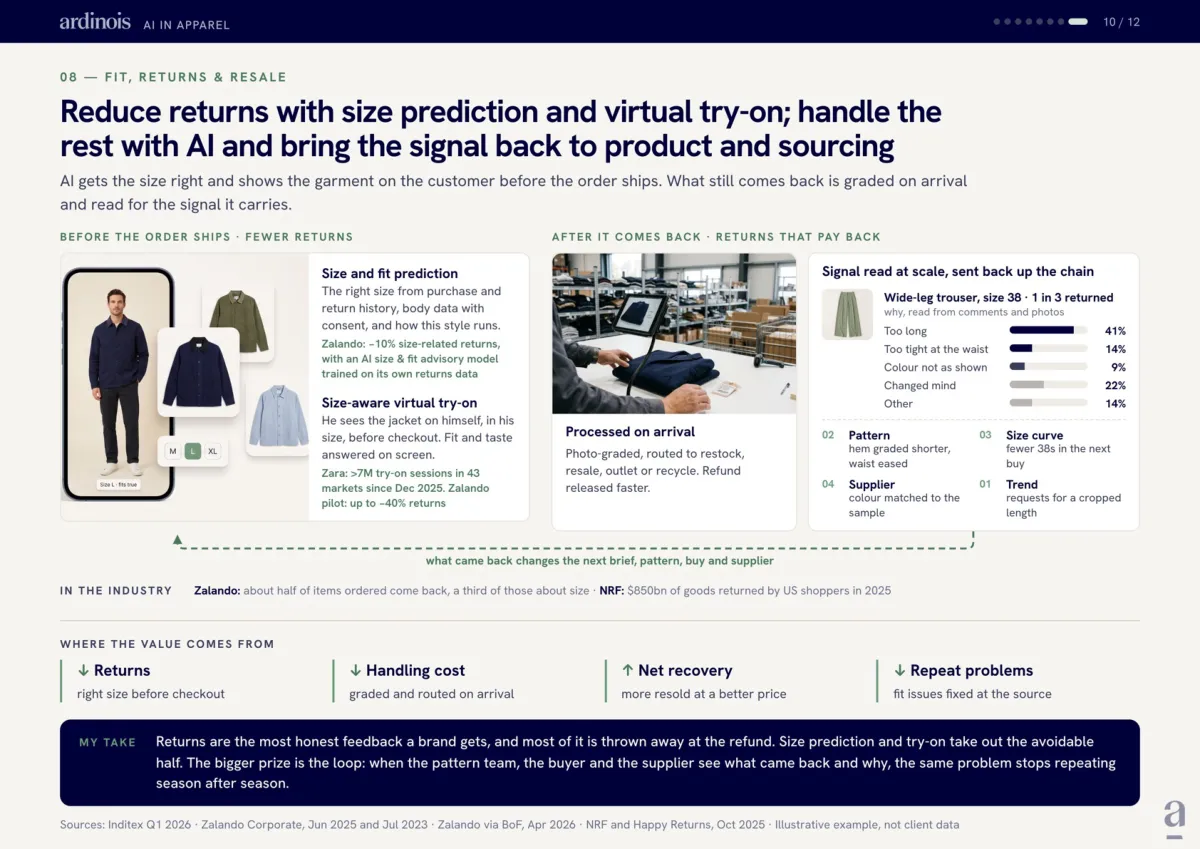
08 Fit, returns & resale
Better size prediction and virtual try-on: fewer returns, cheaper handling.
Already moving
Items with Zalando's AI size advice are returned about 10% less often than similar items without it. Zara has run more than 7 million try-on sessions in 43 markets since December 2025.
Source: Zalando Corporate, Jun 2025 and Jul 2023; Inditex Q1 2026