
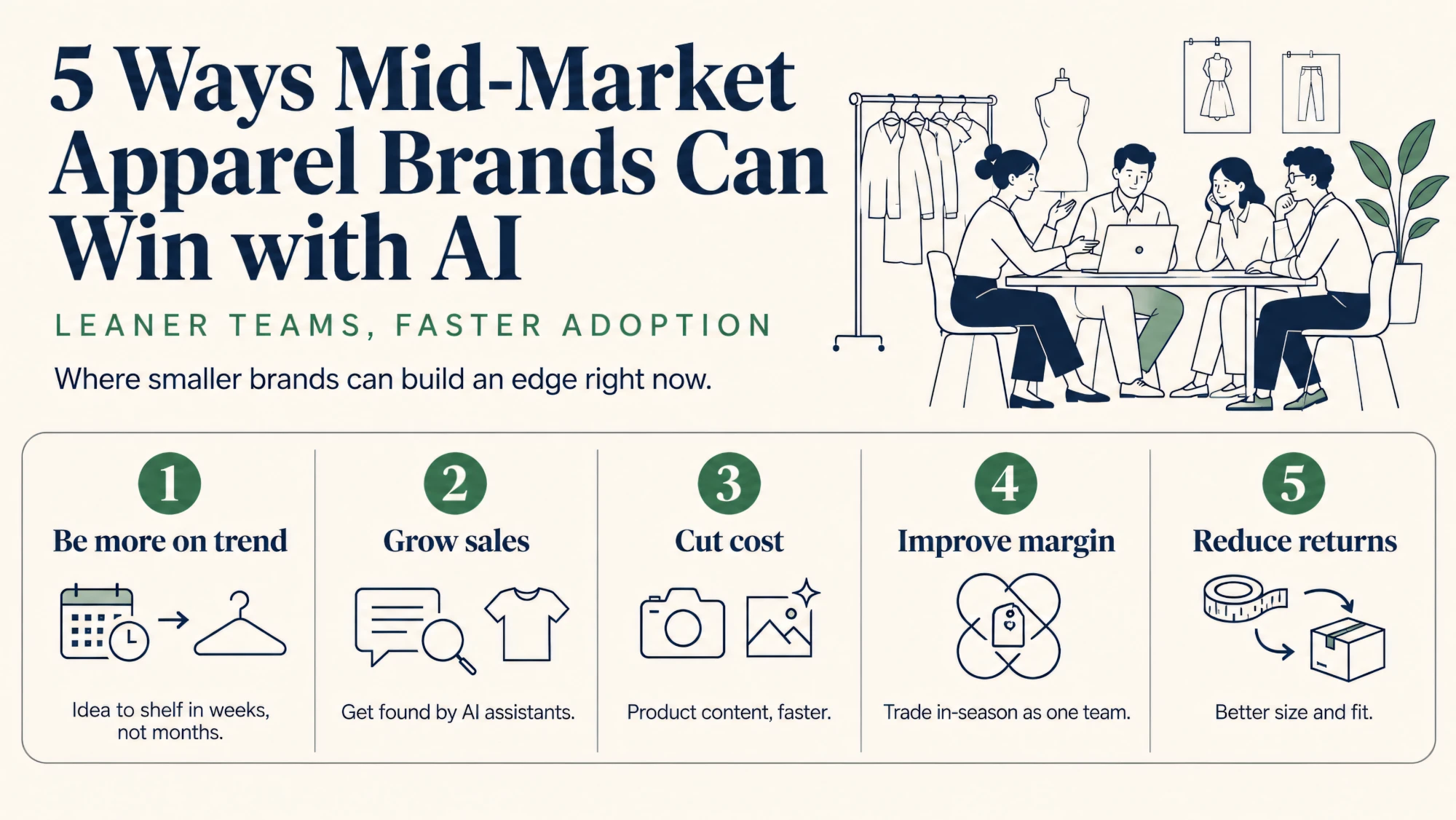
Getting real value from AI means changing how teams work. That is painful inside large organizations with silos and legacy systems. Mid-market apparel brands are leaner and can adapt far faster, if leadership is willing to move. This article covers five places where they can build an edge right now.
Why mid-market brands have the edge
Most of the AI value I have seen in fashion retail came from changing a process: who decides, how often, and with what information. In a large retailer that means aligning several departments, each with its own targets, systems and budget. That takes years.
A brand with a few hundred people has shorter lines. The people who own product, planning, e-commerce and marketing often sit in the same room. And the technology that used to need a large data team is now available from startups and from the vendors these brands already use.
1. Be more on trend: shorten idea-to-shelf
Trends move faster than they used to, and the best way to improve a forecast is to shorten the time horizon. AI now supports most steps in product creation: reading trend signals, generating design options, drafting tech packs and reducing the number of physical sample rounds.
LPP, the group behind Reserved and Sinsay, has shown that this can bring design-to-collection down from 6–12 months to 6–12 weeks. A mid-market team has fewer sign-off layers, so it can adopt this way of working faster.
Where to start: pick one product category and map where the weeks go between first idea and approved sample. Use AI on the two slowest steps first.
2. Grow sales: get found by AI assistants
About a third of US shoppers now use an AI assistant when they shop, up from 12% a year earlier, according to Adyen’s 2026 Retail Report. Those assistants recommend products based on what they can read about them. Products with thin data are less likely to be recommended.
Large retailers have big catalogs and years of product data issues to untangle. A brand with a few thousand styles can get its data complete and structured much faster: materials, fit, occasion, care, and the questions shoppers ask.
Where to start: ask an AI assistant the questions your customers would ask and see whether your products show up. Then fix the data for your top 100 styles.
3. Cut cost: produce product content faster
On-model imagery, product page copy and localized versions take time and budget for every style. Generative AI cuts both. It also lets you show the same item on different models and in different settings.
Large brands are often hesitant here, especially in creative and consumer-facing work. I think the split is fairly clear. Editorial content and brand storytelling stay human-made, because that is what builds the connection with the customer. Product pages are where AI adds practical value.
Smaller brands can move first, and go a step further with things like virtual styling.
Where to start: use AI-generated product imagery on one category and compare conversion and return rates with your current content.
4. Improve margin: trade in-season as one team
Pricing, inventory, marketing and personalization usually sit in separate teams. Each one optimizes its own piece, yet all of them affect margin and working capital.
AI can connect these decisions. When a style is selling slowly, it is far cheaper to rank it higher on the site or send a targeted email than to mark it down. That only happens when the people who own those levers look at the same picture.
In my experience running AI in global fashion retail, this is where the largest gains were. It was also the hardest to organize, because each function had its own targets. A mid-market brand can put the people who own these decisions around one table every week.
Where to start: for your 50 slowest styles each week, agree one next move per style across reorder, stock move, ranking, email, paid and markdown.
5. Reduce returns: better size and fit
Size-and-fit guidance and size-aware virtual try-on are showing good results on fit-related returns. The larger gain comes after that: return reasons, reviews and shopper chats going back to the product team before the next buy, so the fit issue gets fixed at the source.
Where to start: pull the return reasons for your ten most-returned styles and take them to the next product review.
My take
The building blocks are accessible today. Startups and existing tech vendors are enabling all five. Tech that was once gated behind big budgets is now readily available to smaller brands, and they have the edge in adoption right now.
None of this needs to happen at once. Pick the two that fit your biggest problem this year and change the process around them.
These five points come from my report on how AI is changing the apparel operating model, which covers eight decision points across the value chain. Download the report.