
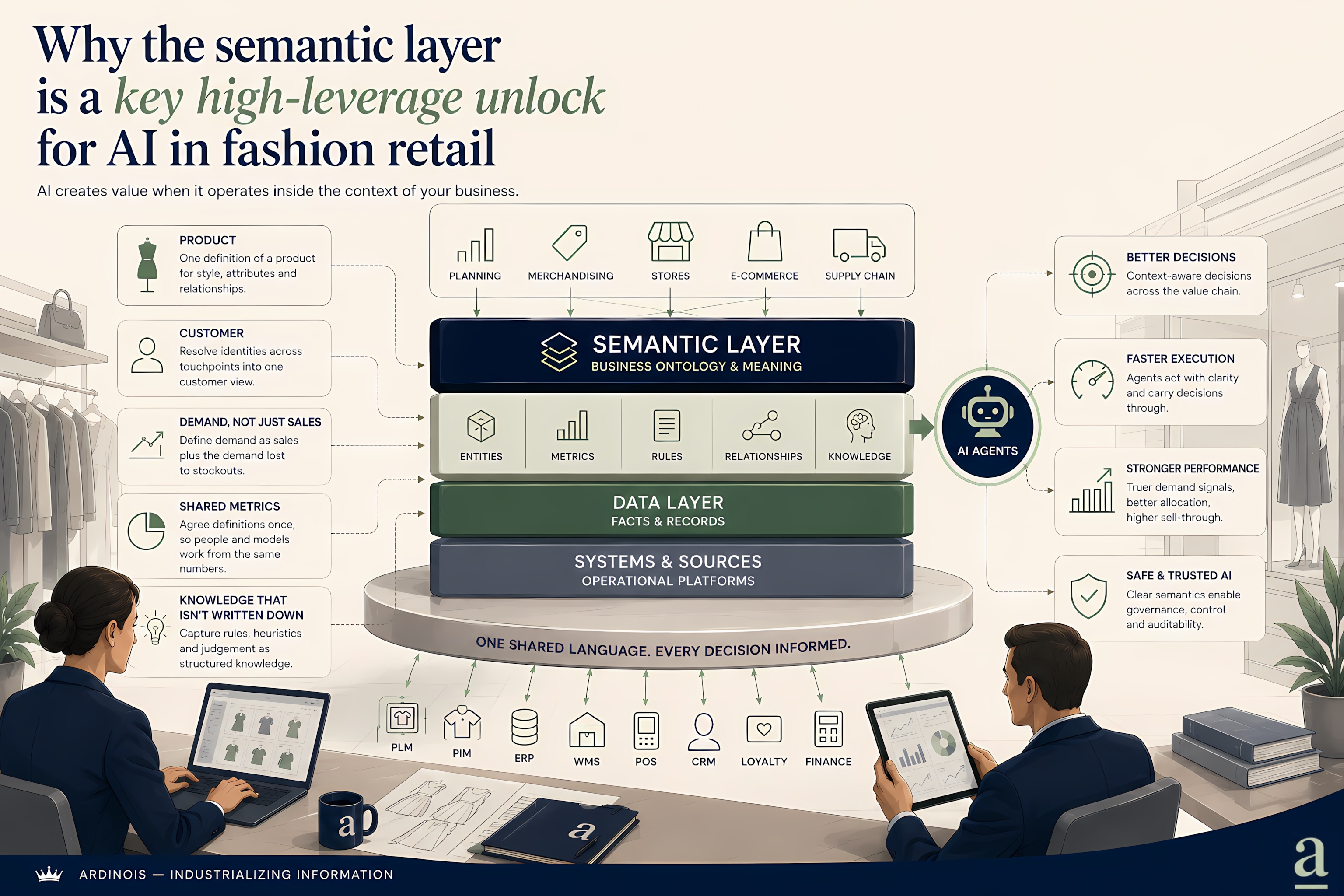
AI creates value when it operates inside the context of a business. A model that understands what your products are, who your customers are, what your numbers mean and how your operation works can support real decisions. The same model without that context can only produce generic output.
That context has a name. It is the semantic layer, and building it is one of the highest-leverage investments a fashion retailer can make in AI right now. It pays off regardless of which models or agent frameworks come next.
What a semantic layer is
A semantic layer is the business ontology made explicit. It defines the core entities a retailer runs on, products, customers, stores, channels, seasons, inventory and demand, along with the metrics and rules that connect them. It maps that meaning to the data and operational systems underneath. And it captures the knowledge that today lives mostly in people’s heads.
A data warehouse stores the facts. The semantic layer defines what those facts mean. Models and agents need the second one to act usefully inside a business.
Why it matters most in fashion retail
Fashion retail runs a long, complex value chain. Design, sourcing, planning, buying, allocation, stores, e-commerce and supply chain each operate as their own discipline, often their own organisation, on their own enterprise systems. The meaning of the business is spread across many silos and many platforms.
That is why a shared semantic layer is both harder to build in fashion and worth more once it exists. It gives a fragmented value chain one consistent set of definitions to work from.
Product data is the part most people picture first, so it is a good place to start. It is also only the beginning.
Product
A product means several things across a fashion business. Design and PLM work in styles. The PIM works in style-colour. The webshop, the warehouse and the till each reference it differently. A clear semantic layer establishes one definition of a product and a controlled vocabulary for its attributes, colour, fit, material and occasion, so a recommendation or visual-search model can reason about it consistently. This is the foundation those use cases assume already exists.
Customer
A guest checkout, an app login, a loyalty scan and a newsletter signup can all be the same person. Resolving them into a single customer identity across CRM, loyalty, e-commerce and point of sale is what lets personalisation work on whole customers rather than fragments. That resolution is a definition the business sets, and the semantic layer is where it lives.
Demand, not just sales
This is where the semantic layer pays off most clearly. Systems record sales. Planning needs demand. When a size sells out, recorded sales fall to zero while real demand continues. Defining demand as sales plus the demand lost to stockouts, and encoding that definition once, gives every forecast a truer signal to learn from. It is one of the most valuable things a semantic layer can hold.
Shared metrics
Sell-through has several valid definitions. Units sold over units received, or over units available. Full price, or all sales. Gross, or net of returns. Merchandising, planning and finance each have a version that is right for their purpose. The semantic layer agrees the definitions so people and models work from the same numbers. Consistent metrics turn model output into something the business can act on directly.
The knowledge that isn’t written down
Experienced planners and merchandisers carry a lot of working knowledge. A style that runs small. A region that over-indexes on outerwear. A rule to hold back part of newness for replenishment. A supplier whose lead times need a buffer. Capturing this knowledge structurally is the highest-value part of building a semantic layer. It is what lets an agent operate with the judgement of a seasoned planner rather than starting from zero.
Why it matters more with agents
With agents, the semantic layer moves from helpful to essential. An agent acts on the meaning it is given. When availability, sell-through and the operating rules are defined clearly, an agent can be trusted to take a decision and carry it through. The clearer the semantic layer, the more an organisation can safely hand to agents, and the more value capable models can deliver. This is what makes agentic automation viable in practice.
How to build it
The most effective approach is to build the semantic layer through the use cases, not as a separate programme. A standalone master-data or ontology effort tends to run long and deliver late. Define the slice of meaning each use case needs, build it properly, and leave it in place as permanent infrastructure. Each use case ships value, and the foundation grows with every one.
Build incrementally, but set the target architecture up front. Getting the architecture right from the start is what keeps the incremental approach clean. It lets each use case build toward a known design rather than ad hoc, which avoids costly migration and technical debt later. There are several established patterns for implementing a semantic layer, so choose the one that fits your landscape deliberately.
The technology is rarely the hard part. The hard part is bringing stakeholders into alignment on the ontology and the semantics: the shared definitions, and the authoritative source for each entity and metric. That alignment is organisational work, not a technical task, and it is where most of the effort and most of the value sit.
You do not need a complete semantic layer to begin. You need to treat meaning as something worth defining and owning.
The retailers getting the most from AI have done exactly that. They have made the semantic layer a deliberate investment and built it one use case at a time. It is the most durable AI advantage available in fashion retail today, and it compounds.