
Microsoft announced Fabric IQ as the connective layer between data and agent reasoning. SAP, Salesforce, Databricks, Snowflake, and ServiceNow have followed in adjacent quarters with their own variants. Gartner’s most recent hype cycle places Context Graphs, Multiagent Systems, Agentic Analytics, and Agentic AI Governance on the rising slope toward the Peak of Inflated Expectations. The term “semantic layer” has moved from data engineering glossaries into executive briefings within a year.
The reflex this triggers in most organisations is the same: which tool do we buy?
It is the wrong reflex.
The concept is not new
A semantic layer has been a working idea for decades. Business intelligence vendors used the term to describe the business-friendly abstraction that translated business terminology into database queries; Business Objects shipped this as the Universe in the 1990s. Tim Berners-Lee, Jim Hendler, and Ora Lassila gave the concept a structural backbone in their 2001 Scientific American article on the Semantic Web, framing it as the foundation for machine-readable meaning on the web. Today’s semantic layer is a fusion of the two traditions: BI abstraction over data, machine-readable meaning across systems, plus the knowledge graph practice that matured in the years between.
What is new is not the concept. What is new is that human-machine collaboration finally makes it urgent.
For a generation, the semantic layer lived inside specialist tools, owned by data engineers, consumed by BI reports. The lack of enterprise-wide adoption did not cause obvious problems because the consumers were human. Humans interpret. They bridge gaps. They notice when an answer is technically accurate to the wrong question and ask again.
Agents do not bridge gaps. An agent reasoning against an ungoverned context produces technically accurate answers to the wrong question and proceeds. Neither the agent nor the user knows the difference.
That is what makes the semantic layer urgent now. Not because vendors have built new tools. Because agents have created a new class of consumer that cannot compensate for the absence of a curated layer.
The hype is real
The market signals are unambiguous.
Microsoft Fabric IQ positions itself as the integration layer across Fabric, Copilot Studio, and Microsoft 365. SAP Business Data Cloud and Joule build knowledge graph capabilities as the substrate for SAP agentic workflows. Salesforce Atlas Reasoning Engine and Data Cloud provide the equivalent positioning for the Salesforce ecosystem. Databricks Genie and AI/BI semantic models extend the lakehouse pattern with governed semantic abstractions. Snowflake Cortex Analyst exposes semantic views as the addressable surface for natural-language data interaction. ServiceNow Now Assist reasons over the existing ServiceNow knowledge graph.
Specialist vendors gain momentum in parallel: Neo4j, Stardog, AllegroGraph, GraphDB, PoolParty, TopBraid. Open-source and platform projects (Cube.dev, AtScale) continue to push the universal semantic layer concept.
Gartner’s commentary positions context as the defining theme of 2026. The hype cycle places multiple agentic and semantic capabilities on the rising slope toward inflated expectations.
The hype is not manufactured. The capability gap it points to is real.
The reflex
When recognition meets hype, the reflex is procurement. Boards ask “which tool?” Steering committees commission vendor evaluations. Procurement teams produce shortlists within a quarter. The recognition was correct; the response converted recognition into a tool selection without an intervening step.
The missing step is design.
A semantic layer is not a product. It is the set of curated concepts, relationships, and access rules that an organisation chooses to make explicit so that downstream systems, including agents, can reason against them. A product, if one is eventually selected, hosts the artefact. The artefact does not arrive with the product.
We have seen this concretely. An organisation implemented a semantic layer tool, shipped two hundred concepts into production without governance, and within six months had agents reasoning confidently against outdated taxonomies because no one owned the update cycle. The product worked exactly as specified. The artefact had drifted. The agents had no way to know.
The pattern repeats. An organisation recognises the need for a semantic layer. The recognition produces a vendor evaluation. The evaluation produces a tool selection. The implementation produces a configured product without a curated artefact. The recognition was correct. The response was wrong.
Why the reflex happens, and what is being skipped
Vendor narratives at the Peak of Inflated Expectations are designed to convert recognition into procurement. That is not a criticism of vendors; it is what their position in the cycle requires of them. Capability claims widen, demos accelerate, and the language of strategic urgency replaces the language of structural readiness.
Organisations follow because the alternative is harder. The alternative requires the organisation to develop conceptual literacy about what a semantic layer is, what it does, where it lives in the architecture, and which existing assets already contribute to it. That conceptual work is slower than a vendor evaluation. It produces no procurement decision in a quarter. It does not feel like momentum.
It is the only thing that produces durable outcomes.
What is missing is conceptual literacy
Conceptual literacy is not a certification programme. It is not generic AI training. It is structured capability development that changes how people evaluate and build, not what credentials they hold. The output is decision-makers who can challenge a vendor proposal in their own language, not employees who have completed a course.
The current wave of AI adoption was carried by a first generation of literacy programmes. These were calibrated for individual support: awareness of what generative AI can do, training on prompt engineering, encouragement to use the tools at hand. They achieved what they were designed to achieve. They are not calibrated for the wave that follows.
Human-machine collaboration is a structural shift. It changes what employees do, what decisions managers make, and what organisations are accountable for. The literacy required to navigate it is different in kind, not in degree. It is not awareness literacy; it is conceptual literacy. It does not answer “what can this technology do?” It answers “how does this technology work, and what does that imply for how we use it?”
Three audiences need this conceptual literacy on materially different terms.
Executive sponsors need to distinguish capability claims from architectural reality. They need to read a vendor proposal and tell a retrieval-augmented system from a fine-tuned model, and to understand why the distinction matters for risk and investment. They need to recognise agent washing in proposals before approval, not after.
Function leaders need to evaluate AI investment cases on their own terms rather than the vendor’s. They need to understand why information quality determines output quality. They need to translate between business outcome and architectural reality without depending on the technology team for translation.
Builders and operators need to apply governance principles consistently. They need to distinguish a workflow with an LLM step from an agentic system. They need to know why the distinction changes the gate.
None of these are technical skills. They are organisational design vocabulary.
A literate organisation can score and evaluate vendors objectively rather than accepting the promise and adopting the lingo. Vendors at the Peak of Inflated Expectations stretch capability claims; that is structural to the cycle, not exceptional. Filtering the noise is essential to avoiding the failures that arrive later. Conceptual literacy is the filter.
The sequence that produces durable outcomes
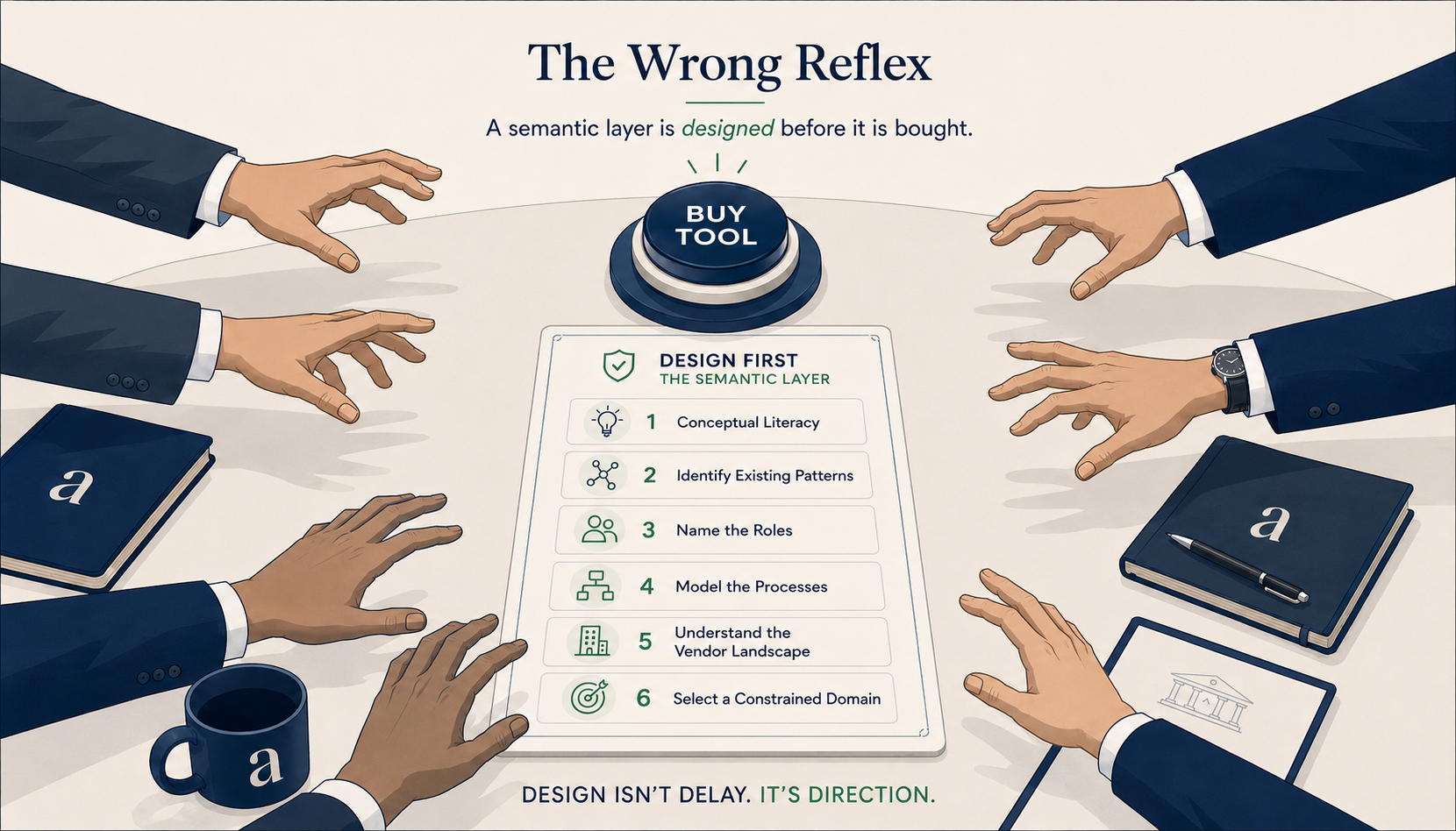
Adopting the semantic layer well requires moving through six phases in order. The phases are short individually; their effectiveness depends on not skipping any of them. Each phase ends when something specific has been observed, not when a date has passed.
-
Develop conceptual literacy across the three audiences. The vocabulary precedes the choice. Without it, every later phase is conducted in the vendor’s language rather than the organisation’s. Phase ends when all three audiences can distinguish a retrieval-augmented system from a fine-tuned model and explain why the distinction matters for risk and investment.
-
Identify existing patterns. Most organisations already have semantic-layer-shaped assets: governed BI models, taxonomies and ontologies in pockets, structured content estates, knowledge bases in service management or HR systems. Mapping what exists is faster than designing from zero, and often produces a sharper picture of what is genuinely missing. Phase ends when the organisation has a documented map of its existing semantic assets and a clear view of what is genuinely missing versus what already exists in fragmented form.
-
Name the roles that will govern the layer. Information stewardship, knowledge curation, ontology design. These are organisational roles, not technical configurations. Without named accountability, the layer drifts as fast as it is built. Phase ends when the Information Steward, ontology owner, and curation accountability are named individuals with mandates, not committees or aspirations.
-
Model the business processes that move information from vocabulary to ontology to operational use. The layer is a process artefact, not a static configuration. It needs creation, review, versioning, and decommissioning workflows from the beginning. Phase ends when those workflows are documented and signed off by the named accountabilities, not described in a future tense.
-
Understand the vendor landscape with critical distance. Knowing what a vendor does and what they claim are different; conceptual literacy makes the distinction readable. Compare propositions against the design that the first four phases produced, not against each other in isolation. Phase ends when the organisation can write a vendor evaluation in its own design language, not the vendor’s, and can explain why each proposition fits or does not fit the design.
-
Select a constrained domain. Run a focused proof of concept or MVP that validates the design choices against operational reality in one bounded part of the organisation. Extend the footprint only after the design holds. Phase ends when the bounded use case operates against the new layer with documented stewardship in place, and the failure modes encountered have been catalogued for the broader rollout.
The first four phases happen before any tool selection. The fifth phase happens because conceptual literacy makes the evaluation honest. The sixth phase happens against a tested design rather than against a vendor pitch.
What getting it right looks like
Not in feature terms. In governance terms.
Organisations that succeed will have named stewards. They will have documented concepts and versioned ontologies. They will have decommissioning processes for what is no longer current. They will have evaluation criteria that survive a vendor demonstration. They will have leadership vocabulary that withstands the next hype cycle.
They will not have the most tools. They will have the most discipline.
The wrong reflex is to skip the design. The right move is to slow down at the start so the speed compounds at the end.