
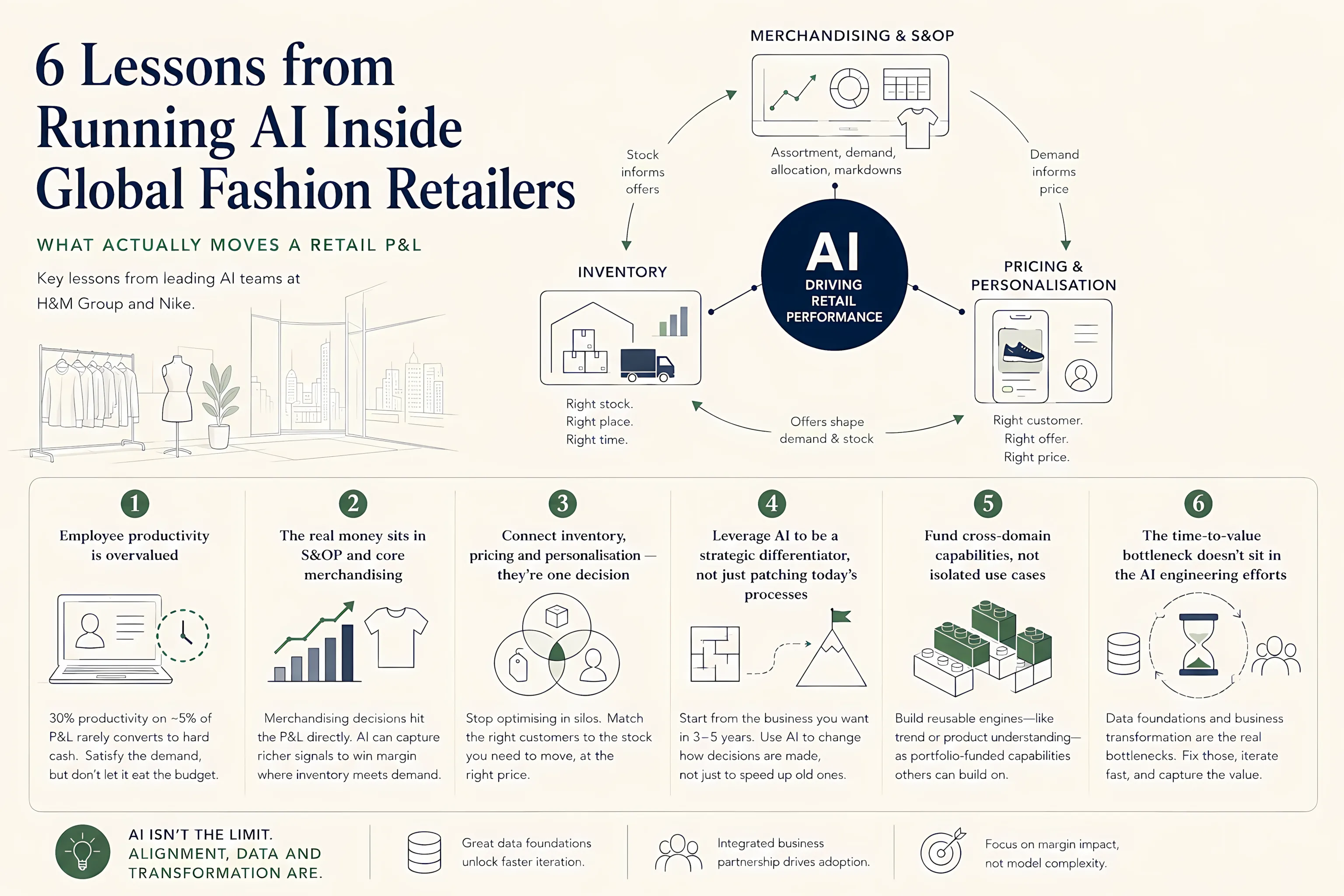
I’ve spent the last years leading AI teams across two of the largest fashion value chains in the world, H&M Group and Nike. Some things worked, a lot didn’t, and along the way I learned what actually moves a retail P&L.
If you’re trying to extract real financial returns from AI at enterprise scale, these are some of my lessons learned.
Employee productivity is overvalued
Ask almost anyone in a corporate office what AI can do for them, and they’ll give you a long list of day-to-day admin tasks they want to simplify or automate. It can absolutely make their workday easier. But building your enterprise AI portfolio around copilots is probably not the best use of resources.
Doing the math, benchmarks show knowledge workers can get 30% more productive through everyday AI. But corporate office payroll is usually only around 5% of a retail P&L. To capture those savings in hard cash, you either have to execute painful restructurings or scale revenue aggressively without hiring a single extra person. Most legacy organisations do neither. The operational friction of capturing that fractional time is massive, so the value stays entirely theoretical.
That said, you can’t ignore corporate staff. They are a loud, influential internal group, and shutting them out kills culture and tool adoption. The job is finding the line: satisfy enough of that internal demand to maintain goodwill, but don’t let it swallow your engineering budget.
The real money sits in S&OP and core merchandising
Retail margin is won or lost in core merchandising: assortment, pricing, inventory allocation. Unlike a 15-minute time saver for a brand manager, merchandising decisions hit the income statement directly and immediately.
This is also the domain where machine learning has been doing the heavy lifting for years, in demand forecasting and markdowns. But there is still massive value to be gained here. Not in the least because the new generation of AI can capture much more and much deeper signal than traditional ML ever could: social trends, deep product embeddings, customer sentiment, external market signals. Exactly the inputs the old models always struggled with.
If you have one euro to spend on AI in retail, put it where inventory meets demand.
Connect inventory, pricing and personalisation — they’re one decision
Most retailers run planning and inventory in one world, and marketing and personalisation in another. Different teams, systems, and KPIs. That separation is a huge missed opportunity.
Especially true for in-season operations. Product is sitting on shelves or in the warehouse, and at the same time the personalisation engine is optimising for incremental revenue on whatever it predicts you’ll click. Rather than just pushing whatever product consumers might buy, a better question is: which consumers have a real propensity to buy the stock we actually need to move, and at what price?
Connecting those worlds is where a lot of margin sits. Pushing the right product to the right customer before it hits markdown is worth more than the extra basket from a generic recommendation.
Leverage AI to be a strategic differentiator, not just patching today’s processes
When scoping new initiatives, the default request from business units is usually: “How do we make our current process faster or more efficient?”
That question caps your upside immediately. Using new technology to optimise an old, inefficient process just gives you a faster bad process.
Instead, start with what your business should look like 3 to 5 years out. Define that strategic target, unconstrained by today’s operational habits, and work backward to figure out how software and data get you there. Don’t ask how AI automates today’s weekly markdown review; ask how AI changes the way buying decisions get made mid-season.
- Enablers make an existing process slightly less painful.
- Differentiators change your competitive position entirely.
Fund cross-domain capabilities, not isolated use cases
Truly differentiating with AI requires complex technical assets, like an enterprise-wide trend engine or deep product and consumer understanding. These are the capabilities that fuel proper personalisation, forecasting and more.
The standard corporate mistake is scoping these assets inside a single project. When you do that, two things happen: either the project looks way too expensive because it carries the full infrastructure cost, or the team builds a minimal version that doesn’t scale, is too specific, and leaves the next team to rebuild it six months later.
Map out cross-domain capabilities that serve multiple functions across the business. Treat them as foundational infrastructure, fund them from a portfolio perspective, and let multiple teams build on top of them.
The time-to-value bottleneck doesn’t sit in the AI engineering efforts
None of the above works if your data landscape is fragmented or the business isn’t ready to change. Iterating fast and working integrated are the keys to succeeding. You want to test an idea, learn, and kill it quickly if it isn’t working.
That only works if two conditions are met.
First, the data landscape. I’ve seen it over and over again: a first viable product takes months. Not because the AI part is hard, but because the data you need sits in isolated systems or warehouses, or the quality simply isn’t good enough. So instead of iterating with the business, the team spends its first months on data discovery, engineering, and plumbing. Every use case pays that tax again. With AI agents this gets even more critical: an agent can only be effective at scale if it can navigate your enterprise landscape in a uniform way.
Second, the business. When use cases are created by leadership or product teams that aren’t integrated enough with the operation, the tech gets built in a vacuum. It can be technically brilliant and still deliver nothing. If the process doesn’t change, if the tool isn’t adopted, if the operational counterparts don’t trust the team or the output, none of the value gets realised. I’ve seen more AI value lost to a missing transformation effort than to a bad model.
So the AI team is never just the AI team. Data foundations and business transformation have to run alongside the tech, integrated from day one, not bolted on when the pilot is “done”.