
First in a series on industrializing information
We live in an information society. This has been broadly accepted for decades. Executives nod along in strategy meetings. “Data is the new oil” has become so worn it’s almost meaningless. What has not followed is a corresponding reorganisation of how organisations are designed and managed.
Walk into most organizations and you’ll find structures designed for a different era entirely. Hierarchies built to coordinate physical production. Planning cycles calibrated to stable, predictable markets. Information systems that treat data as exhaust—a by-product of “real” work rather than the work itself.
The shift was acknowledged but the organisational response never fully materialized.
The pattern we keep repeating
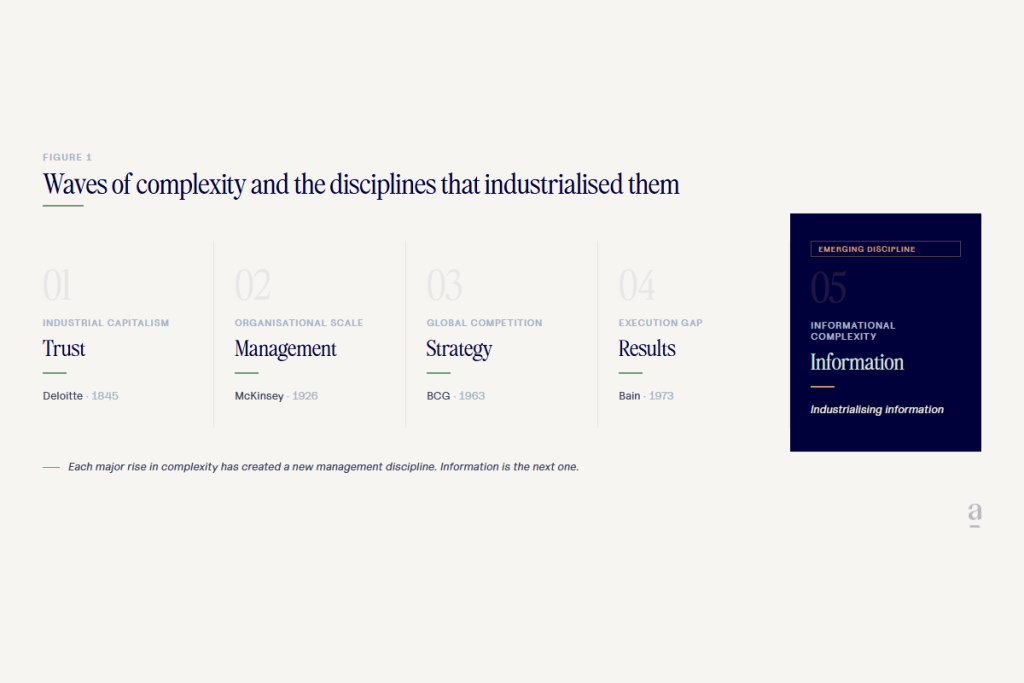
Every major shift in economic complexity has eventually produced a new management discipline—and a consulting industry to industrialize it.
When the scale of industrial capitalism outgrew what family owners could oversee, financial accountability became essential. Deloitte, founded in 1845, didn’t just audit railway companies. It industrialized trust. It created repeatable methods for verifying that capital was being used as promised, enabling the investment that built modern economies.
When enterprises grew too complex for intuition alone, management itself became a discipline. McKinsey, founded in 1926, brought “management engineering” to corporate decision-making. What had been art became method. What had been personal judgment became organizational capability.
When global competition demanded not just efficient operations but strategic positioning, another discipline emerged. BCG, founded in 1963, industrialized strategy—creating frameworks like the growth-share matrix that made portfolio decisions systematic rather than instinctive.
And when strategies kept failing in execution, Bain, founded in 1973, industrialized results—tying consulting fees to measurable outcomes and building long-term partnerships focused on implementation, not just advice.
Each wave followed the same structural pattern: when complexity exceeded what intuition could handle, a new management discipline emerged to make it governable at scale.
The complexity we haven’t named
Today’s dominant complexity is obvious to everyone who works in a modern organization. It’s not financial trust, management structure, strategic choice, or execution discipline—though all of those still matter.
It’s information.
Not the absence of information. The overwhelming, fragmented, poorly-governed, context-free abundance of it. Organisations accumulate vast amounts of data while struggling to convert it into shared meaning. They have dashboards but not decisions. Analytics platforms but not understanding. AI pilots but not intelligence.
The symptoms are everywhere. Teams don’t trust reports because everyone interprets them differently. Decisions that should take days take months because the information exists but can’t be found, combined, or verified. AI initiatives produce confident nonsense because they’re built on foundations of poorly-structured knowledge. The best insights remain locked in individuals’ heads, walking out the door every evening—or permanently, when people leave.
This is not primarily a technology problem. Organisations have invested heavily in platforms, integration layers, and analytics capabilities. These investments address storage, processing, and access.
What remains unresolved is how information is produced, interpreted, and acted upon as part of everyday management.
Why this is harder than it looks
Information is a strange kind of raw material. Unlike iron or oil, it doesn’t deplete when used—it often increases in value. Unlike financial capital, it’s difficult to measure on a balance sheet. Unlike management structures, it doesn’t respect organizational boundaries.
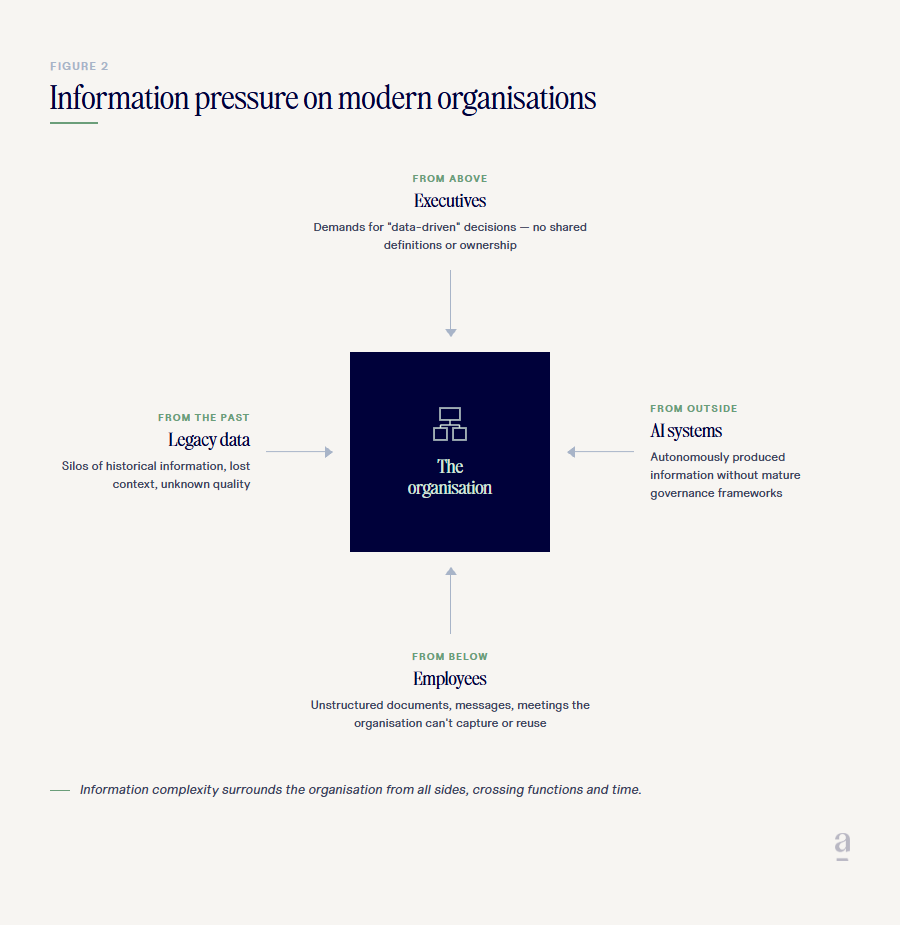
And unlike previous waves of complexity, information challenges arrive from multiple directions simultaneously.
From above: executives demand “data-driven decision making” without agreeing on what data means or who owns it.
From below: employees generate vast quantities of unstructured knowledge—documents, messages, meetings—that the organization cannot capture or reuse.
From outside: AI systems now produce information autonomously, requiring governance frameworks that don’t yet exist.
From the past: decades of accumulated data sits in silos, poorly documented, its context lost, its quality unknown.
No single function owns this problem. IT manages infrastructure but not meaning. Analytics teams build models but not organizational capability. Knowledge management—where it exists at all—handles documents but not decisions.
The result is what one executive described to me as “extremely sophisticated ignorance.” The organization knows more than ever and understands less than ever.
What industrializing information actually means
When Deloitte industrialized trust, it didn’t just check ledgers. It created standards, methods, professional training, and governance structures that made financial verification reliable and repeatable across thousands of organizations.
When McKinsey industrialized management, it didn’t just give advice. It developed frameworks, built organizational capabilities, and created a discipline that could be taught and scaled.
Industrialising information requires the same kind of organisational ambition. Not another platform, dashboard or AI pilot but a discipline.
That means treating information as capital—with ownership, stewardship, and measured returns. It means building production processes for knowledge, with the same rigor manufacturing applies to physical goods. It means designing organizations where information flows by intention, not accident. It means developing literacy—not just technical skills, but the ability to think in the languages of data, narrative, and systems.
This is not something technology can deliver alone. Technology can store, transport, secure, and process information. It cannot decide what deserves to be known, when uncertainty is acceptable, or who is responsible for meaning.
Those are management questions. They require a management discipline.
What comes next
This is the first in a series exploring what it means to industrialize information. In the posts that follow, I’ll examine:
- Why treating information as a by-product creates structural, not accidental, risks
- Why the reflexive focus on productivity is precisely the wrong response
- Why most AI initiatives fail—and what the successful ones do differently
- What organizational structures actually work for informational complexity
- How to build an information operating model with clear ownership and governance
- What “information literacy” really means, beyond buzzwords
The organizations that master this transition won’t just adopt AI or build better dashboards. They’ll redesign how decisions are made, how knowledge is created and shared, and how value is produced in an economy where information is both the raw material and the product.
The shift to an information society has already occurred.
The corresponding organisational redesign is still catching up.
This is the first post in a ten-part series on industrializing information. Next: “Information Is No Longer a By-Product.”