
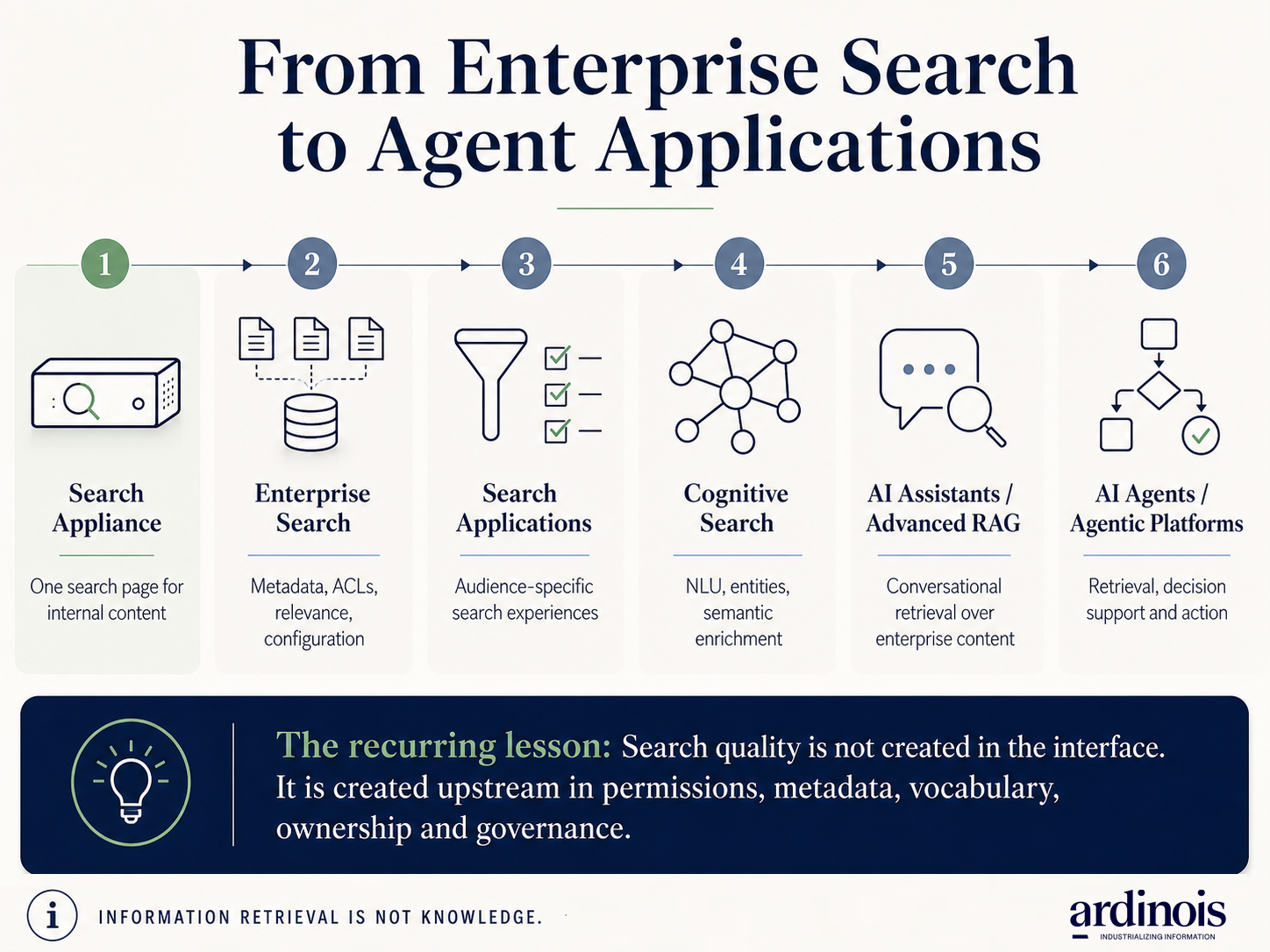
Every major technology wave changes what organisations expect from their internal information systems.
When smartphones became mainstream, companies wanted responsive intranets and better mobile UX.
When social platforms grew, companies wanted internal platforms that felt like “the Facebook for our company”.
When digital content exploded, companies wanted a simple search experience:
“We want a Google page for our intranet.”
The promise was understandable. Employees wanted one place to search across documents, folders, policies, project material, contracts, knowledge articles and business systems. The idea was simple: type a question or keyword, get the right information back.
The implementation was never simple.
The enterprise search era
In the early 2000s, the Google Search Appliance became one of the most visible symbols of that ambition. It was a physical yellow box, deployed in the customer’s data center and configured to index organisational content.
The promise was simple: a Google-style result page for internal information.
But behind that simple interface sat a much more complex reality.
Enterprise search had to deal with different content sources, access rights, metadata, folder structures, document quality, relevance rules and organisational vocabularies. It had to understand not only where information was stored, but also who was allowed to see it, what it meant, and which result should be considered relevant in which context.
The 2010s became the golden era for search appliances and enterprise search platforms.
Microsoft acquired FAST Search in 2008 and integrated the technology into SharePoint. Organisations using SharePoint could benefit from more powerful search capabilities than the standard SharePoint Search experience of that time.
FAST could index content from various sources. It allowed organisations to define relevance rules, work with metadata, configure search pipelines and tune the search experience beyond a basic result list.
But the work was technical and organisational.
Search quality depended on crawled properties, managed properties, index schemas, content sources, access control, relevance ranking and continuous monitoring. Administrators and consultants needed to understand the principles of enterprise search, not only the product configuration.
Looking back, the lesson was not that search technology was difficult.
The lesson was that search quality was never only a search problem.
It depended on permissions, metadata, content ownership, vocabulary, source quality, relevance rules and continuous governance.
That same lesson is now returning in enterprise AI.
Search quality was never only technical
Enterprise search exposed a structural issue in many organisations.
Information was available, but not always organised.
Documents existed, but ownership was unclear.
Metadata was present, but inconsistent.
Access rights were technically configured, but not always aligned with how the organisation actually worked.
Different departments also had different ideas of relevance. Legal teams might expect legislation and case material to appear first. Finance and administration teams might prefer contracts, invoices or supplier information. HR teams might search for policies, procedures and employee guidance.
There was no one-size-fits-all search experience.
Good enterprise search required more than an index. It required information organisation.
That meant defining taxonomies, facets, metadata models, source priorities, security models and search experiences for different audiences. It also meant accepting that there was no magic box that captured information the way the organisation wanted it without doing the groundwork.
From search applications to cognitive search
As enterprise search matured, the focus moved from result pages to search applications.
Organisations started building search experiences for specific use cases, departments and audiences. Faceted search, metadata-driven filtering, source prioritisation and domain-specific vocabularies became important parts of the design.
Later, cognitive search added new possibilities.
Natural language understanding, machine learning, entity extraction, semantic enrichment and expert finding moved search beyond keyword matching. Search platforms started to surface knowledge, uncover relationships and connect people to information in more intelligent ways.
But the core challenge did not disappear.
Cognitive search still needed reliable sources, clear access rules, meaningful metadata, well-designed vocabularies and governance over content quality.
Technology improved.
The organisational work remained.
The agent application of today
The enterprise search problem of yesterday is reappearing inside the agent applications of today.
Much of the current agent and Copilot discussion is about information retrieval: give access to enterprise data and the agent will surface the information employees need.
It is a conversational way of retrieving information.
But the same challenges are relevant again: surfacing the wrong information, connecting different sources, tailoring information to the requesting user, defining information scope per agent, enforcing access control and deciding which source is authoritative.
Information retrieval is not the end of the story.
Organisations are moving from information retrieval to decision support, autonomous task execution and orchestrated implementations of agents.
That progression raises the stakes.
A search engine returned a list of links.
An agent may summarize, decide, trigger a workflow or change a system of record.
From retrieval to action
The market now uses different terms for this evolution.
- Advanced RAG grounds LLM-powered answers in verified enterprise content, with source attribution and access control.
- Enterprise AI Assistants provide conversational interfaces that answer employee questions across enterprise content sources.
- Enterprise AI Agents execute multi-step workflows that search, synthesize and act on enterprise knowledge.
- Agentic AI Platforms provide the infrastructure to deploy governed, secure and enterprise-grade agents at scale.
Each layer adds capability.
Each layer also adds risk.
When retrieval is wrong, an answer may be wrong.
When decision support is wrong, a recommendation may be wrong.
When an autonomous agent is wrong, a process, transaction or system of record may be affected.
That is why information and knowledge organisation become more important, not less.
The same lesson, with higher stakes
The lesson from enterprise search was simple, but often ignored:
Search quality is not created in the search box.
It is created upstream, in the way information is named, owned, structured, secured, enriched and maintained.
Agent applications make this lesson more important. To execute tasks reliably, an agent needs access to the same organisational context a competent human would need: vocabulary, policies, permissions, source hierarchy, process rules, exceptions and accountability boundaries.
AI is not something an organisation simply deploys.
It is something an organisation designs.
And the design work starts long before the agent interface. It starts in vocabularies, taxonomies, metadata, access models, knowledge graphs, source governance and clear accountability for meaning.
Information retrieval is not knowledge.
It only becomes knowledge when it carries context, trust, provenance and purpose.