
Most enterprises now have access to the same cloud data platforms, the same foundational models, and the same boutique implementation partners. Yet the business returns produce a stark divide.
Recent industry data consistently points to organisational structure, rather than raw technology, as the primary driver of success:
- The value gap: BCG research indicates that only around 4% of enterprises generate systemic value from their Data & AI investments, with high performers allocating roughly 70% of their efforts to people, process, and culture, 20% to data architecture, and just 10% to models and algorithms.
- The failure rate: Project failure rates across enterprise data science and AI deployments routinely exceed 80% — roughly double that of traditional IT initiatives. Research from RAND highlights that the leading driver of failure is poor problem definition and organisational misalignment, rather than weak technical performance.
- The P&L disconnect: MIT studies on enterprise generative deployments show that roughly 95% of pilots fail to make a measurable impact on the P&L statement, emphasising the gap between technical proofs-of-concept and scalable data products.
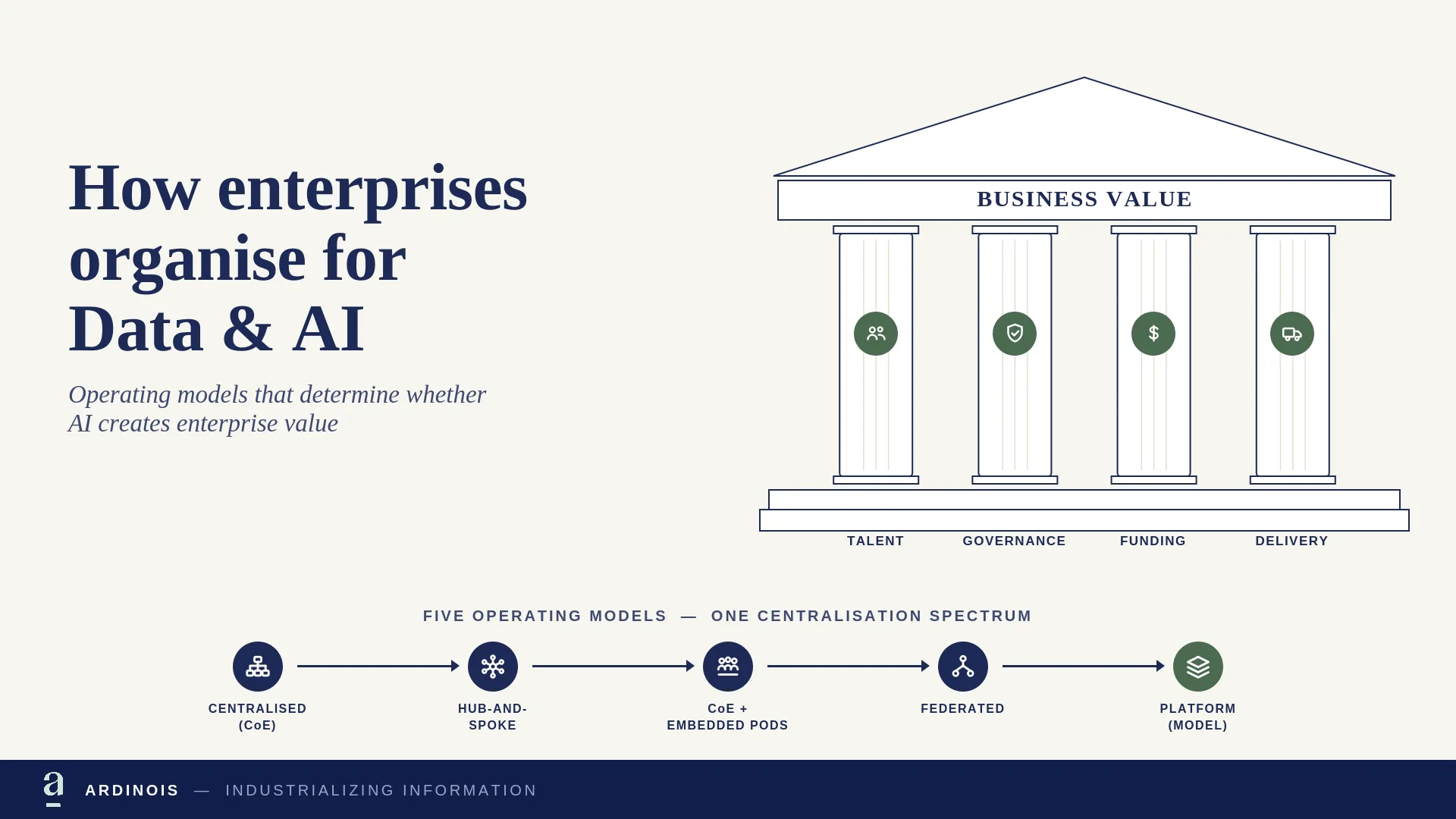
Where data and AI talent sit, who owns governance, how platforms are funded, and where decision rights reside determine which side of these statistics an enterprise lands on.
Below is an examination of the five primary Data & AI operating models in use today, their trade-offs, and where each succeeds. They sit on a continuum ranging from strict central authority to complete delegation across business units.
Centralised: the Data & AI Centre of Excellence
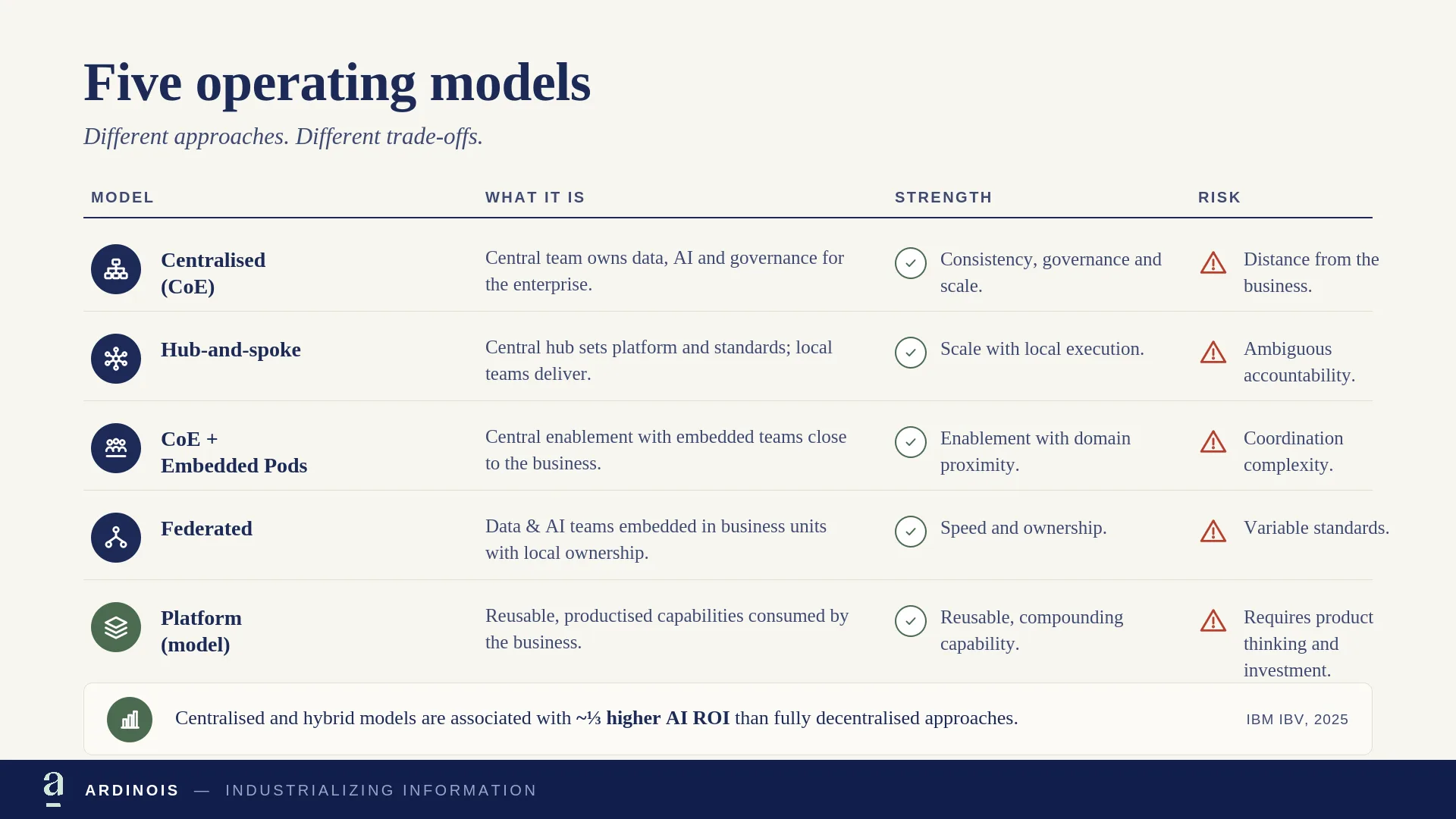
A single central division holds the majority of data engineering, data science, analytics, and AI governance capability. Reporting directly to a Chief Data & Analytics Officer (CDAO) or CIO, the Centre of Excellence (CoE) acts as both the primary delivery engine and the governing body for the enterprise.
Key advantages
- Consistency: Data modelling, engineering standards, tooling, and architectural patterns are strictly unified across the enterprise.
- Straightforward governance: Compliance policies, data quality rules, and safety guardrails are defined once and enforced universally.
- Concentrated talent: Scarce specialists sit together, accelerating internal skill development and technical quality.
- Cross-cutting scope: The team can execute foundational initiatives that individual business units lack the budget or mandate to fund.
Primary risks
- Operational bottlenecks: The central team becomes a queue where business units compete for delivery bandwidth.
- Loss of business context: Distance from daily business operations yields technically elegant data pipelines and models that miss operational nuance.
- Hand-off friction: Long feedback loops between central builders and business-unit owners slow down time-to-value.
Best contexts: Early-stage digital maturity; smaller enterprises; heavily regulated sectors where risk mitigation and auditability supersede speed; contexts where data quality and compliance outweigh rapid experimentation.
Decentralised: federated and embedded
Data engineers, analysts, and AI practitioners are embedded directly into specific business units. Teams report into business unit leadership with deep domain focus. Central authority is minimal, with governance enforced via platform policies rather than explicit central approval gates.
Key advantages
- Speed: Teams build, iterate, and deploy data products rapidly without waiting on central review queues.
- Domain alignment: Solutions directly address specific operational problems because builders work alongside business stakeholders.
- Clear accountability: Ownership of the data, the problem, and the outcome sits within a single business unit.
Primary risks
- Duplication: Multiple business units independently spend resources solving identical data or modelling problems.
- Divergent standards: Metrics, data definitions (such as “active customer”), and technical practices fracture across divisions.
- Governance gaps: Oversight relies on local discipline, increasing compliance, security, and data quality risks.
- Siloed insights: Operational breakthroughs and clean data assets produced in one unit rarely benefit the rest of the enterprise.
Best contexts: Organisations with high baseline data maturity; distinct, autonomous business units; cultures disciplined enough to uphold shared technical standards without central enforcement.
Hub-and-spoke: the hybrid
A central hub manages core data infrastructure, enterprise platforms, data governance, and baseline standards, while localised spokes execute domain-specific analytics and AI builds. A formal community of practice connects the two, allowing local innovations to be standardised and shared enterprise-wide.
Key advantages
- Balanced scale: Combines enterprise-wide consistency with local business agility.
- Reduced infrastructure duplication: Shared data infrastructure at the hub prevents spokes from rebuilding baseline capabilities.
- Talent community: Specialists maintain a central professional home while focusing on business-unit challenges.
Primary risks
- Boundary friction: Ambiguity regarding where hub responsibility ends and spoke responsibility begins causes delivery friction.
- Resource drag: If the hub retains too much custom delivery work, it reverts to a centralised bottleneck.
Best contexts: Mid-to-large enterprises moving past initial experimentation; organisations scaling data and AI capabilities across multiple core functions. Global research indicates that hub-and-spoke models consistently deliver higher return on investment compared to fully decentralised setups.
CoE plus embedded pods
A refinement of hub-and-spoke. The central CoE focuses on platform architecture, enterprise data modelling, complex R&D, and risk management. Small, multidisciplinary squads (pods) consisting of data engineers, analysts, and software developers are embedded inside business units. Senior domain leaders act as Data & AI Champions, linking operational goals to central capabilities.
Key advantages
- High alignment: Embedded pods focus entirely on unit priorities while leveraging central data platforms and standards.
- Structured knowledge sharing: Central visibility ensures successful pod patterns and data products are quickly repurposed enterprise-wide.
- Clear career paths: Technical professionals benefit from deep domain work without losing connection to central engineering peer groups.
Primary risks
- Dependency on champions: Success hinges heavily on the authority and technical judgment of business-unit champions.
- Competing priorities: Pods risk being pulled into short-term ad-hoc reporting and operational fixes at the expense of building durable capabilities.
Best contexts: Large enterprises with multiple distinct business lines that possess sufficient scale to justify dedicated technical pods.
The platform and data mesh operating model
Central platform teams build reusable, self-service assets — cloud data lakehouses, automated data pipelines, model hosting, retrieval systems (RAG), and evaluation tooling. Business teams treat their data and models as “data products”, consuming platform components to build custom workflows. Funding shifts from one-off project budgets to continuous platform investment.
Key advantages
- Compounding value: Shared platforms and reusable data products become more cost-effective with every internal team that builds on them.
- Built-in governance: Access control, data lineage, and safety guardrails are integrated directly into platform APIs and data products.
- Lifecycle ownership: Product funding supports continuous technical health rather than a build-and-hand-off cycle.
Primary risks
- High upfront capex: Requires substantial capital investment before operational business value becomes visible.
- Execution complexity: Demands mature software engineering, product management, and data governance capabilities across the enterprise.
Best contexts: Technically mature organisations operating Data & AI across dozens of teams; enterprises willing to invest in shared infrastructure ahead of immediate return. This model frequently sits underneath a hub-and-spoke structure.
How modern AI shifts the data operating model
The rise of generative models and autonomous agents changes how data capabilities are assembled, shifting operational demands in four specific areas:
- The quality of unstructured data: Generative AI relies heavily on unstructured enterprise data (documents, tickets, transcripts, code). Operating models must expand traditional data management to cover document pipelines, vector indexing, and retrieval architectures alongside traditional SQL databases.
- From building to integrating: Enterprise effort has shifted from training models from scratch to orchestrating, grounding, and evaluating existing frontier systems. Engineering focus should be reserved for proprietary enterprise data, context grounding, and last-mile system integration rather than commodity infrastructure.
- Shift in technical skill sets: Demand has broadened from traditional predictive data science toward software engineering, data architecture, and integration. MLOps and DataOps have converged into unified LLMOps and Data Platform Engineering.
- Agentic governance and decision rights: Autonomous agents introduce distinct governance requirements because they execute tasks and query data without direct human intervention. Current consensus advises managing agent data access through existing identity frameworks, maintaining a central agent registry, and defining clear decision boundaries for every automated workflow.
There is no best operating model
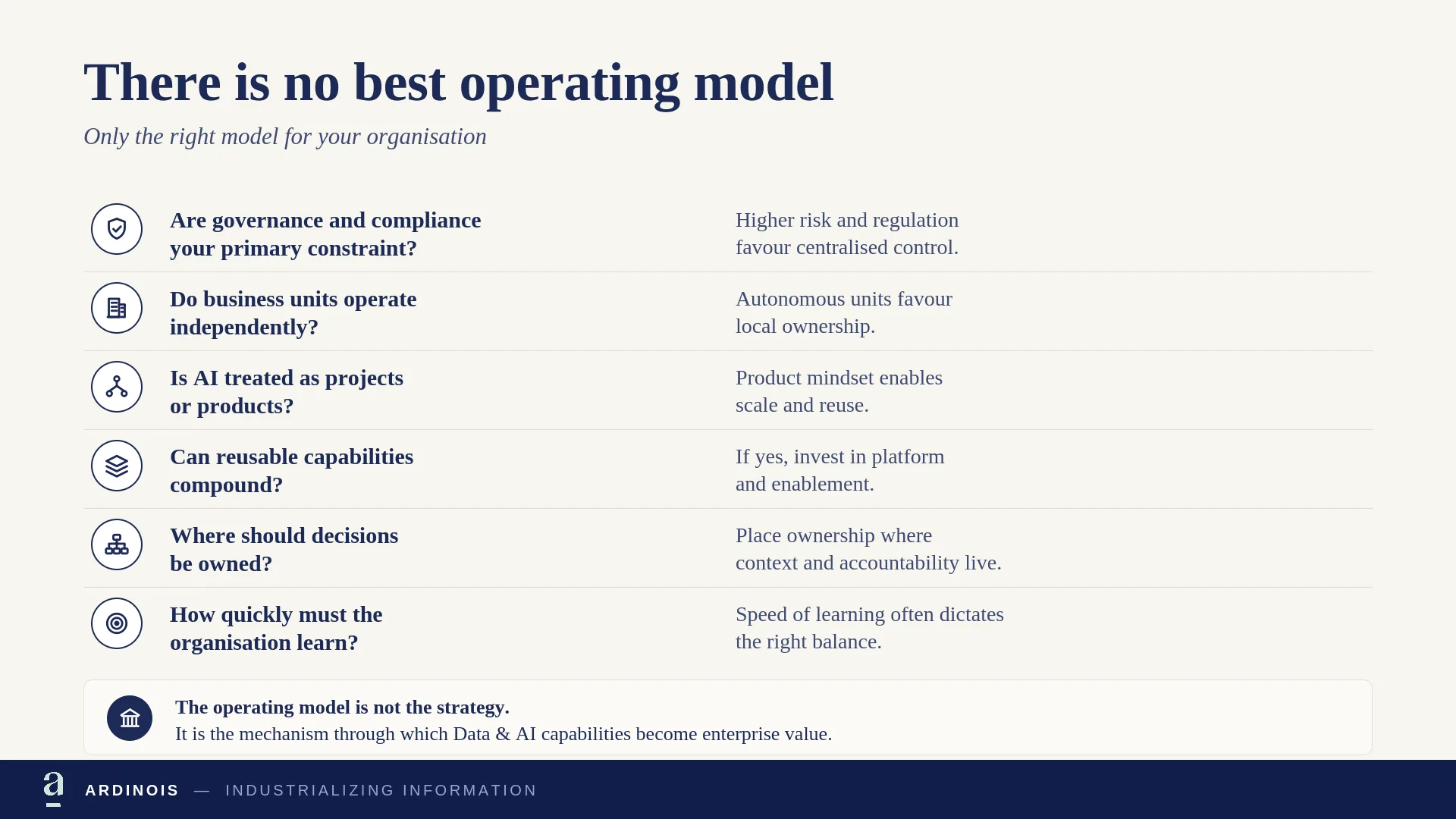
No single structure remains permanent. Enterprises typically start centralised to establish baseline data quality and governance, transition to hub-and-spoke to enable scale, and introduce self-service platform capabilities as technical maturity develops.
The structural model chosen is simply the delivery mechanism. Sustainable value depends on linking that structure directly to core operational decisions, funding shared data platforms that compound, and governing capabilities deliberately.