
Every technology cycle creates words that become popular faster than they become understood.
This is happening again.
The Analist voice
At the Gartner Data & Analytics Summit in March, “Context is King”, “Semantic Layers are Mainstream” and “Missing Context is an AI Risk” were among the recurring messages.
The Vendor Reaction
Microsoft’s Work Trend Index speaks about Owned Intelligence: institutional know-how that compounds over time, is unique to the firm, and is hard to replicate. Microsoft is also moving further with Work IQ, Fabric IQ and Foundry IQ as intelligence layers across its ecosystem.
Google announced Workspace Intelligence, giving Gemini more contextual understanding across Gmail, Drive, Docs, Sheets, Slides, Calendar and Chat.
People building more advanced agents with Claude, OpenAI or other platforms are running into the same reality: without memory, context and meaning, agents remain mostly transactional. They retrieve. They respond. But they do not reliably reason within the operating logic of an organization.
“The barrier is educational, not technical” was on one of the keynote slides at the Knowledge Graph Conference this week in NYC.
One of the strongest lines.
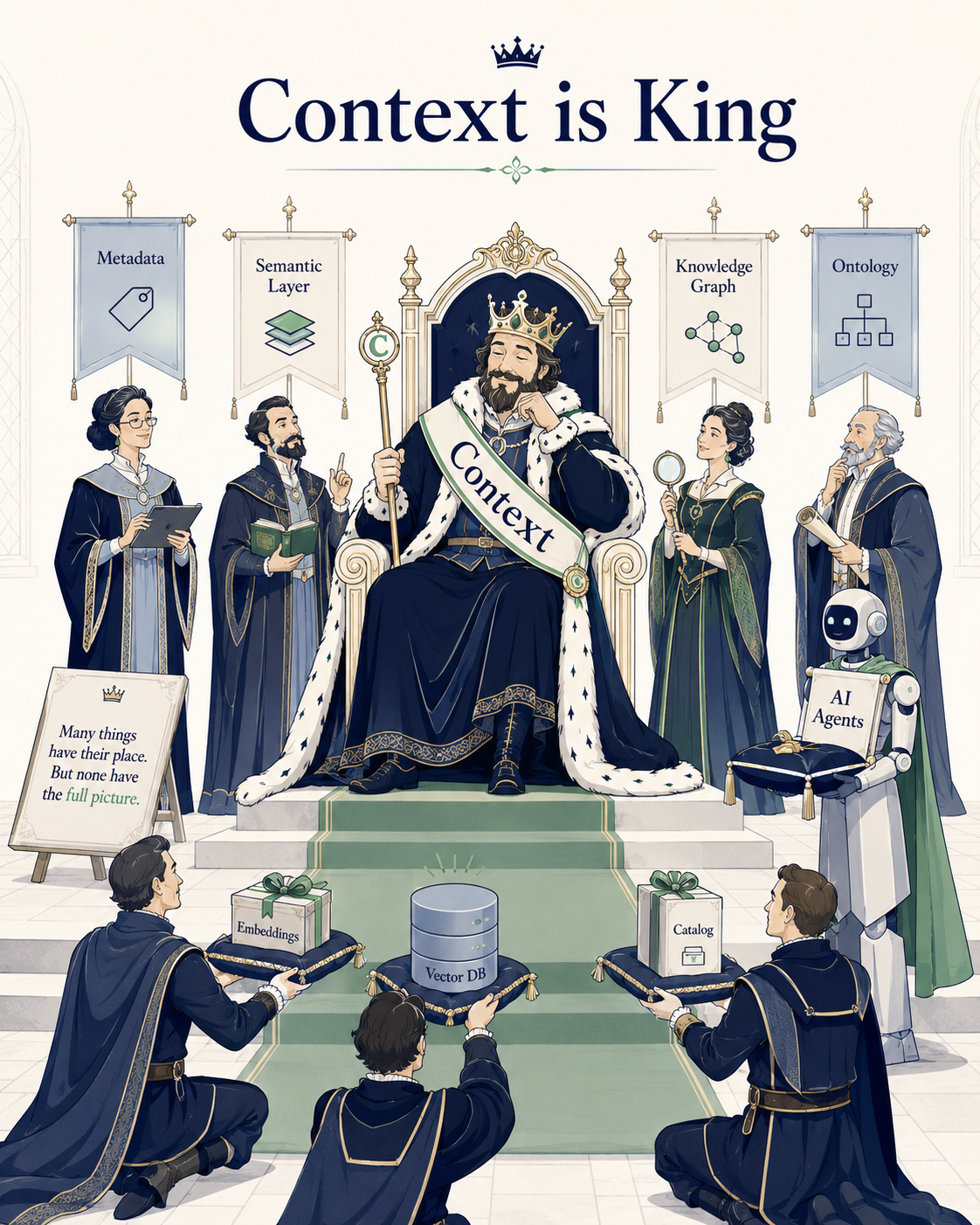
’The Context Layer’ is emerging in numerous papers, keynotes and vendor language. Context. Semantics. Semantic Layer. Knowledge Graph. Metadata. Ontology. AI Agents.
What is the market doing?
In most of our assignments, these topics are becoming more prominent. Creating context and enabling meaning for reasoning systems is central to AI scaling and value creation. And I can’t agree more with the sentiment at the Knowledge Graph conference: the barrier is educational.
The Challenge
It was educational in the first wave, when focus was on personal productivity and trying to understand what AI could mean for the individual employee.
Today it is educational across the board: business, data, IT, architecture, governance and leadership all need enough shared understanding to make good strategic and technical decisions.
Teams may think they have solved meaning because the renamed data fields, created metric definitions, added embeddings or bought a catalog. They have not.
A semantic layer for BI is not the same as enterprise semantics. A vector database is not a context layer. Metadata is not meaning by itself. A knowledge graph is not automatically governance. An ontology is not a taxonomy with more expensive words.
The question is not ‘which buzzword do we need?’. The question is ‘What must the organisation make explicit so people, systems, and aI agents can act on shared meaning’.