A European recruitment services group with a clear growth strategy: grow organically and grow through acquisition. The strategy was sound. The technology function was not designed to carry it.
The situation
The group’s IT department had been built for a different purpose. It managed the workplace: telephony, endpoints, hardware, the network. It did this well. But workplace management is a cost discipline, not a growth discipline. Every acquisition arrived with its own tooling, its own processes, and its own data conventions. Integration was handled case by case, and each integration consumed more capacity than the last.
The core of the business showed the same pattern at a smaller scale. Matching candidates to vacancies depended on what individual recruiters carried in their heads: their own network, their domain knowledge, their keywords. The systems stored documents. The knowledge that connected those documents lived in people. When a recruiter left, the matching capability left with them.
These are not two problems. They are one problem observed at two levels. The organisation produced information locally and owned it nowhere.
The approach
We redesigned the technology function from a workplace manager into a platform organisation. That is an operating model decision before it is an architecture decision: it defines what the function is accountable for, which is no longer devices and connectivity, but the processes, data, and information the business runs on.
On that foundation we designed the platform itself, structured in deliberate layers:
- Systems of record for the core domains: recruitment, HR, finance and operations. Each domain keeps one system of record. Tooling that duplicated a record was rationalised out.
- An integration and data foundation owned by the group, not by its vendors. Connectors bring data out of the systems of record into a single service architecture, where candidates, employees, and customers exist as defined, governed entities rather than as documents scattered across applications.
- Standardised journeys built on top: acquisition and communication for candidates, learning, payroll, and wellbeing for employees, vacancies, timesheets, and invoicing for customers. The journeys consume the platform. The platform owns the data.
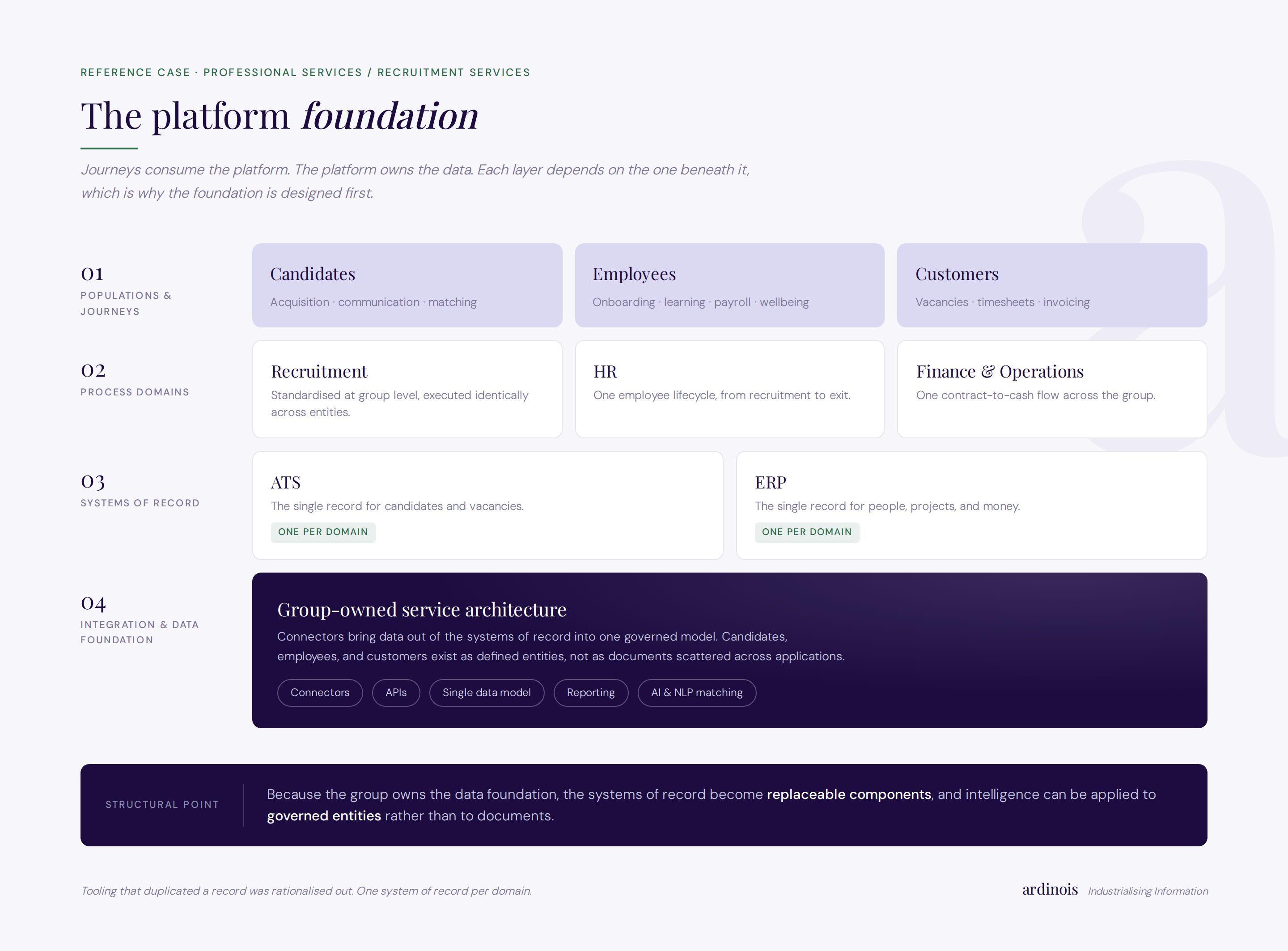
The decisive design choice sits in the middle layer. Because the group owns the data foundation, the systems of record become replaceable components rather than constraints. And because the entities are defined once, intelligence can be applied to them: matching moved from a person-dependent activity to a platform capability, with AI and natural language processing working on governed candidate and vacancy data.
The result
Four outcomes, each a consequence of the design rather than a separate initiative:
- Process standardisation. Core processes are defined once at group level and executed identically across entities.
- Tooling rationalisation. One system of record per domain. Overlapping applications were retired, with their licence and integration costs.
- Ownership of data and information. Candidates, employees, and customers are governed group assets, not artefacts of whichever tool happened to store them.
- A repeatable acquisition path. Acquired companies onboard onto the same stack through the same sequence: map the processes, rationalise the tooling, migrate the data, activate the journeys. The cost of integration falls with every repetition, which is precisely what a buy-and-build strategy requires.
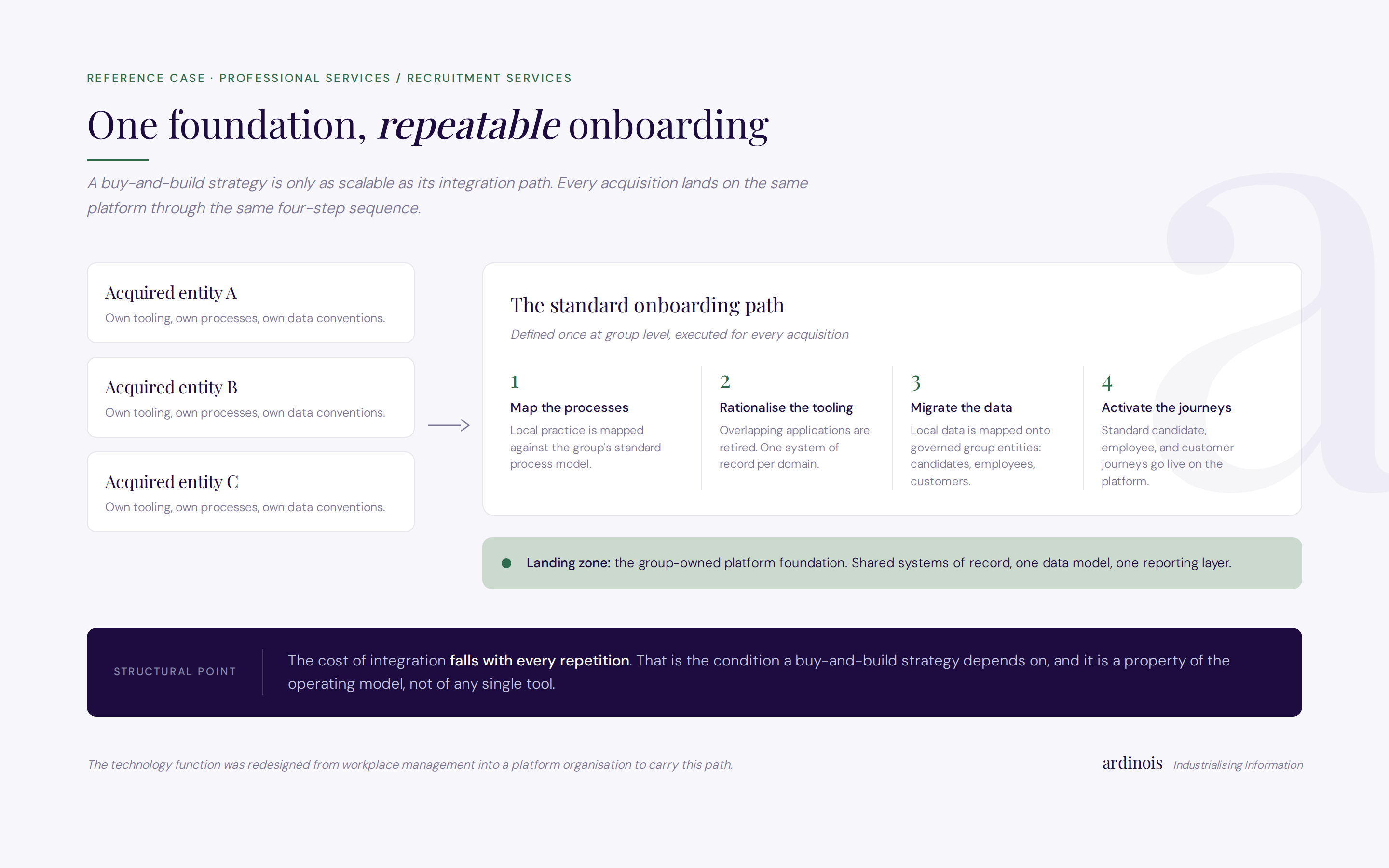
There is a fifth outcome that matters more over time. A platform in which entities are defined, governed, and owned is the precondition for agentic capability. Agents act on information. An organisation that does not own its information cannot delegate work to systems that consume it. This group can.
Why this matters beyond recruitment
The pattern is general. Most professional services organisations run on knowledge that lives in individuals and documents that live in tools. Growth, whether organic or acquired, multiplies both. The way out is not another application. It is an operating model in which the organisation, not its vendors and not its individual experts, owns the production of information.
That is the discipline Ardinois builds.