Part 1 of 4 — AI Transformation: From Ambition to Impact
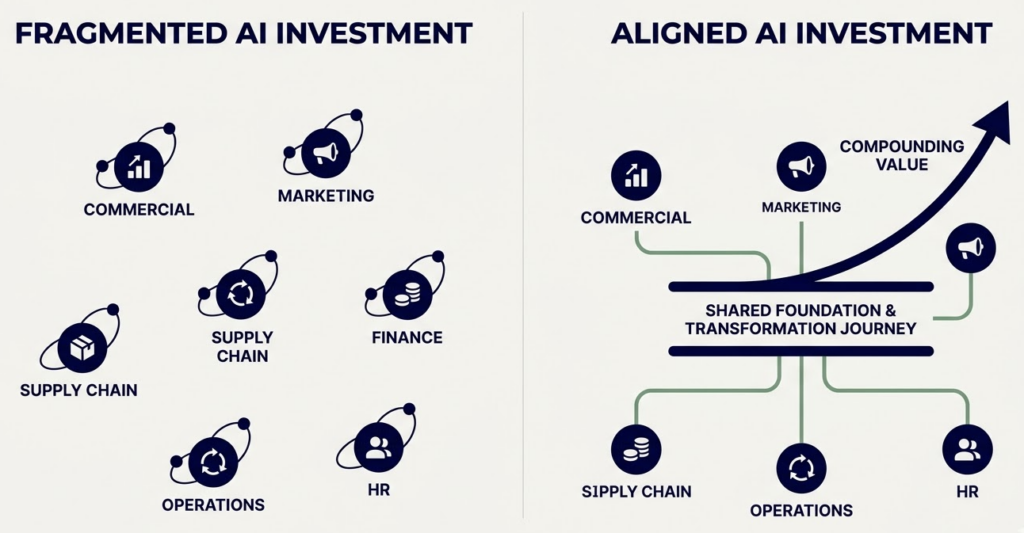
AI investment usually starts with a burst of energy and a lot of separate budgets. A few years in, most large organizations find themselves owning a collection of expensive ‘islands’,isolated tools that work well within their silo but don’t talk to each other.
When you look across a global enterprise, you realize you’ve been paying for the same foundational work multiple times. The bottleneck isn’t just the technology; it’s reinventing the wheel and repeating the same transformation journey every time a new project starts.
Shared foundations let every new initiative build on the last
In many organisations, there is no central mandate for how AI gets built and delivered. Individual business functions engage separately — with vendors, technology partners, or their own teams — to develop AI for their specific processes. Each does so with good intentions and often real energy.
What happens in practice is that all of these initiatives end up doing much of the same work independently. They build the same foundational components. They run their own version of a change programme. They make the same early mistakes. The organisation is effectively paying for that effort multiple times over, without the learning accumulating anywhere.
The alternative is to institutionalise the things that should not need to be rebuilt each time: the data and integration layer, the core technical components, and the change process itself. That does not mean centralising all AI delivery — it means being clear about what belongs in shared infrastructure and what is genuinely specific to a function. Getting that distinction right is where the compounding begins.
AI delivers more value when it connects people across the organisation
When AI initiatives run in isolation, there is no shared sense of what is being built or why. That might seem like a communication problem, but the consequences are more practical than that.
Each initiative ends up with its own tooling, its own user experience, its own way of working. People in different functions use different systems, developed independently, with no common thread. Collaboration across functions becomes harder, not easier — and a significant part of the value in AI often sits exactly at those cross-functional boundaries: in demand and supply alignment, in connecting customer insight to product decisions, in making information flow more freely across the business.
There is also something lost in terms of how the organisation learns. When AI tools are siloed, useful applications that emerge in one team rarely surface to others. There is no mechanism for good ideas to travel. Conversely, a tool that could genuinely benefit multiple parts of the business stays confined to the function that commissioned it.
A more connected approach does not require everything to be the same. But it does require enough of a shared layer — in experience, in ways of working, in how initiatives are communicated — that people across the organisation feel part of the same direction of travel.
Capability and knowledge stay in the organisation
One of the less visible benefits of a more aligned approach is that expertise accumulates. When initiatives are connected, what a team learns on one project is available to the next. Vendor relationships, technical knowledge, and lessons from what did not work all become organisational assets rather than individual ones.
This matters more than it might seem. In fragmented programmes, a significant amount of effort goes into rediscovering things that have already been learned elsewhere in the business. A shared approach reduces that quietly expensive pattern.
Consistent measurement makes the portfolio easier to manage
When each initiative measures success in its own way, it becomes difficult to compare investments, learn from them, or make a clear case for continued funding. Aligning on a common measurement approach — even a simple one — makes the portfolio significantly easier to manage and improve over time.
In practice, two questions are usually enough to anchor this: what business outcome is this initiative trying to affect, and how will we know if it has worked? Agreeing on those answers before an initiative starts, and revisiting them honestly during and after, tends to improve both the quality of investment decisions and the credibility of AI programmes with senior leadership.
The compounding effect is the point
What makes aligned AI investment worthwhile is not any single initiative — it is what the approach makes possible over time. Each initiative that builds on a shared foundation makes the next one a little faster, a little cheaper, and a little more likely to succeed. Knowledge stays. Infrastructure improves. The organisation gets better at this, collectively.
That is the case for treating AI capability as an organisational asset. Not because it sounds strategically tidy, but because the practical returns on that approach tend to significantly outpace those of running initiatives independently.