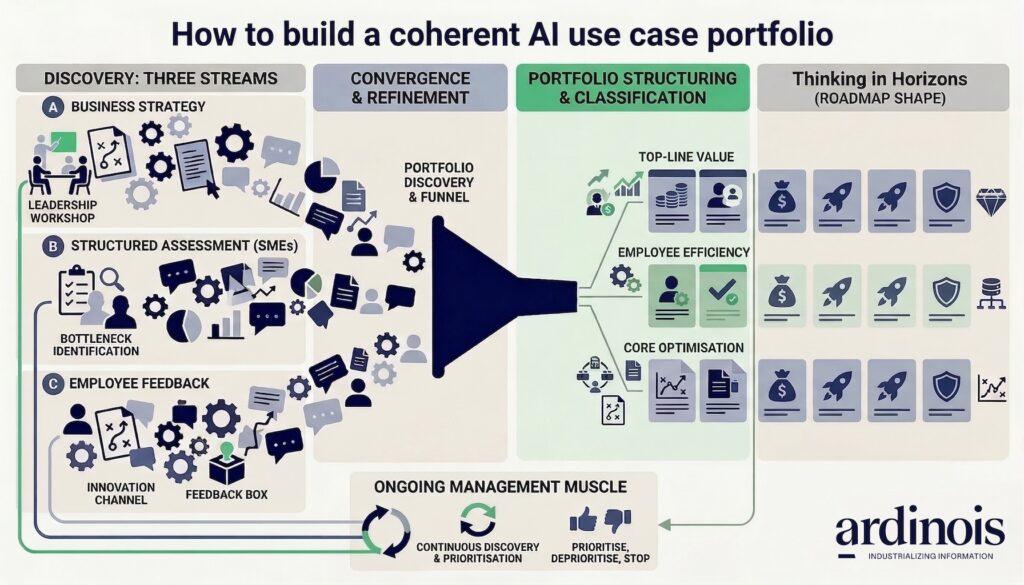
How to build an AI use case portfolio: a practical framework
Part 2 of 4 — AI Transformation: From Ambition to Impact One of the questions I get most often is some version of: “What is the AI use case that…
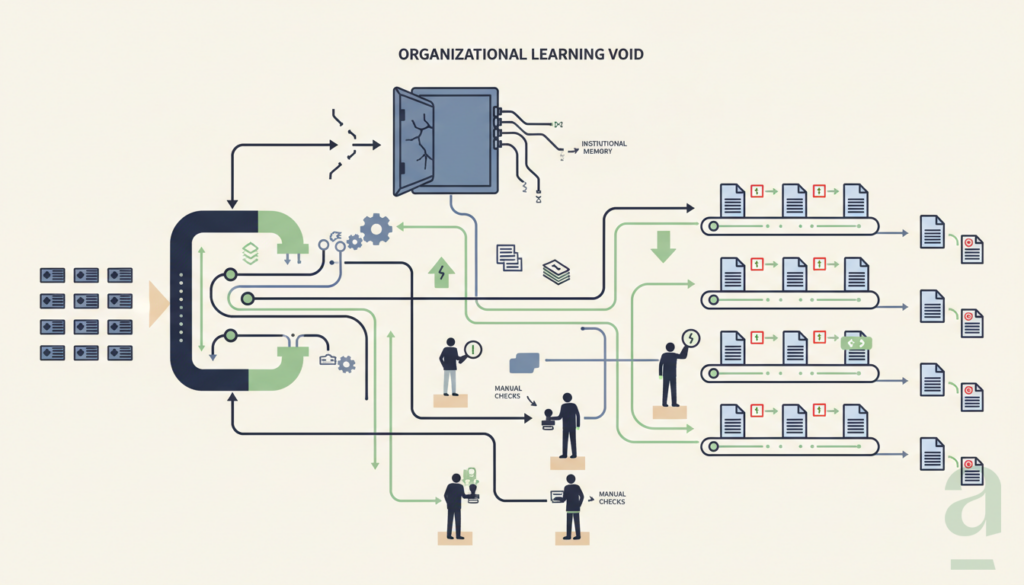
Why AI initiatives fail
And why the explanation is organisational, not technical Enterprise AI is not failing because the models are weak. It is failing because most organisations are not designed to absorb, validate,…
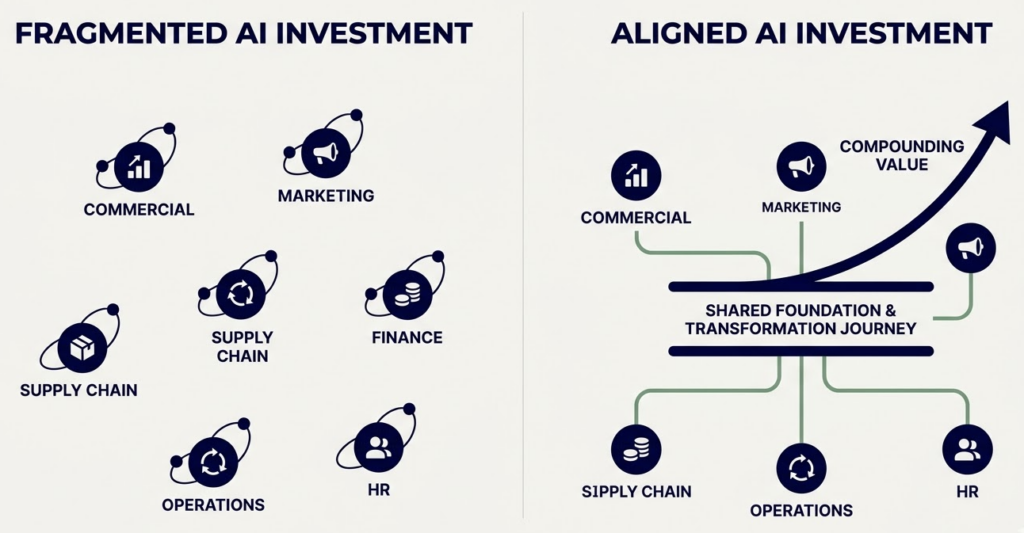
How aligned AI investment builds compounding value.
Part 1 of 4 — AI Transformation: From Ambition to Impact AI investment usually starts with a burst of energy and a lot of separate budgets. A few years in,…

The Productivity Trap
A familiar management reflex still dominates organisational thinking: if we optimise output per unit of time, everything else will follow.
Productivity is assumed to be unambiguously good. More productivity, better outcomes. Organisational success is framed as the aggregation of individual efficiency: more features shipped, more reports generated, more emails processed, more meetings attended.
For a long time, this logic worked. In an industrial economy, productivity thinking was the correct response. Materials were stable. Processes were linear. Environments were predictable. Scientific management, time–motion studies, and standardisation delivered extraordinary gains. They helped build the modern industrial world.
But we no longer operate in that context. Applied to information work, productivity thinking produces pathological outcomes.
From Industrial Age to Information Society
We live in an information society. This has been broadly accepted for decades. Executives nod along in strategy meetings. “Data is the new oil” has become so worn it’s almost meaningless. What has not followed is a corresponding reorganisation of how organisations are designed and managed.
Walk into most organizations and you’ll find structures designed for a different era entirely. Hierarchies built to coordinate physical production. Planning cycles calibrated to stable, predictable markets. Information systems that treat data as exhaust—a by-product of “real” work rather than the work itself.
The shift was acknowledged but the organisational response never fully materialized.