
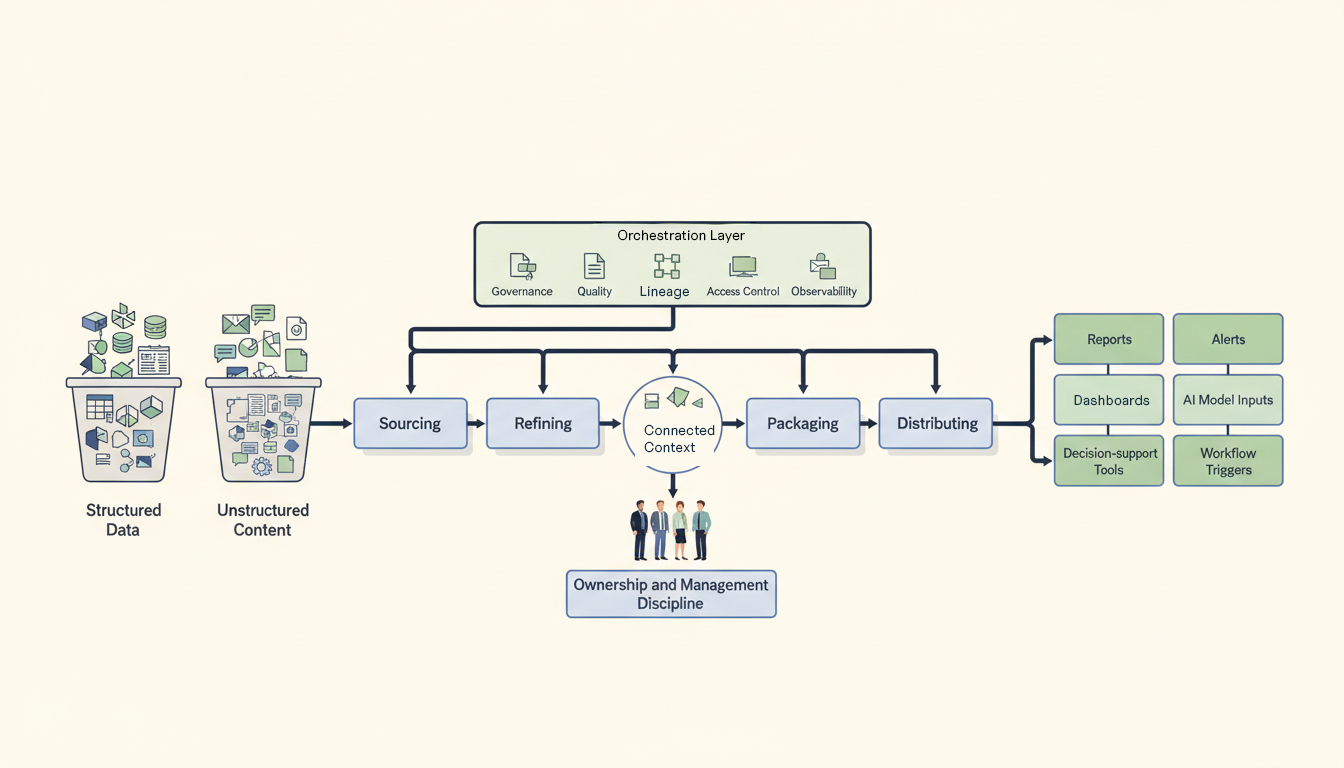
The organizations succeeding with AI have not found better algorithms. They have built better production systems for information.
Most organizations treat information as a natural resource that accumulates through business operations. Data flows in from transactions, sensors, documents. Systems capture it. Storage expands to accommodate it. The assumption is that more information automatically means more capability.
It does not. Without deliberate production processes, information does not become knowledge. It becomes inventory**.**
Most organizations are not information-poor. They are inventory-rich and knowledge-poor.
The Industrialization Precedent
Before industrialization, production was artisanal—skilled craftspeople creating one-of-a-kind items. Quality was inconsistent, output was limited and knowledge lived in individual heads.
Industrialization standardized production into distinct stages with defined inputs, processes, and outputs. The innovation was not in making better products—it was in making products reliably, repeatedly, at scale.
Organizations now face an equivalent transformation with information. The raw material, information itself, exists in vast quantities. The challenge is converting it into something usable, verifiable, and scalable.
Two Production Lines
Information arrives in two forms, each requiring different production approaches.
Structured information—transactions, metrics, sensor data—captures what is happening. This data is quantitative, precise, machine-readable. Organizations have substantial infrastructure for handling it, though often with uneven quality.
Unstructured information—documents, communications, meeting notes—explains why things happen. It contains context, reasoning, narrative. It exists in vast volumes but remains largely untapped. Most of my clients still suffer from an Enterprise Search hangover.
Both forms are necessary. Structured information alone delivers measurement without understanding. Unstructured alone provides narrative without quantification. The value emerges when both production lines operate together.
A manufacturing defect appears in quality metrics (structured), but root cause explanation lives in engineering notes (unstructured). Customer sentiment shifts visible in transaction data become actionable when connected to reasons expressed in service interactions.
Building the Production Process
Creating reliable information products requires the same discipline factories apply to physical goods. Five stages define the production flow.
SourceInformation enters through deliberate collection rather than passive accumulation. This means deciding what information matters, where it originates, and under what conditions it should be captured. Sourcing requires governance—clear policies on what gets collected, how consent is managed, when data should be retired.
RefineRaw information contains errors and inconsistencies. For structured data, this means validation, deduplication, normalization. For unstructured content, this means metadata enrichment, entity extraction, and classification.
AssembleIndividual data points become meaningful when connected to context. Assembly combines datasets into coherent structures—knowledge graphs showing relationships, dashboards integrating multiple sources, analytical models revealing patterns.
PackageAssembled information must be delivered in formats that serve specific uses. Packaging creates information products—APIs exposing data to applications, reports communicating findings to executives, models powering decision systems. Each product has defined specifications: content, update frequency, access controls, accuracy guarantees.
DistributeInformation reaches the people and systems that need it through controlled channels. Alerts trigger when anomalies appear. Search enables retrieval when answers are needed. Automation activates when conditions are met.
Quality as Production Requirement
The best factories build quality into every production stage rather than inspecting finished products. The same principle applies to information.
Embedding quality means defining measurable standards and monitoring them continuously. For accuracy, validation rules catch errors at the source. For completeness, systems track what is missing. For timeliness, monitoring flags when data becomes stale relative to the decisions it must support.
Capgemini’s research on quality engineering shows that organizations successfully deploying AI shifted from testing finished products to continuous quality monitoring. The same shift is required for information production.
European pharmaceutical companies implementing the EU Data Quality Framework establish quality dimensions—accuracy, completeness, consistency, timeliness—at the point of collection. Quality becomes a production requirement, not an inspection activity.
Data Contracts: Interface Specifications
When manufacturing splits across functions, interface specifications become essential—precise definitions of what each function delivers. Information production requires the same rigor.
Data contracts define these interfaces. A contract specifies what information one team provides to another: schema, update frequency, quality guarantees, permissible uses. Implicit dependencies become explicit.
Without contracts, information flows operate on assumptions that create silent failures. One team expects daily updates; another provides weekly. Decisions degrade without obvious symptoms.
Organizations implementing data contracts report fewer integration failures and faster problem resolution. When information fails to meet specifications, accountability and corrective action are clear.
Centers of Excellence
Manufacturing quality improves when production lines combine multiple specializations. Information production requires the same combination.
Centers of Excellence bring together business domain experts, technical specialists, and analytics professionals. These are not governance bodies. They are production units.
They own information products end-to-end, from sourcing to delivery, rather than coordinating from a distance.
Cap Geminis World Quality Report 2025 documents this shift in organizations successfully integrating AI. Central oversight gives way to distributed production teams embedded in delivery.
European energy company Vattenfall established data stewardship teams combining domain knowledge with technical capability, producing validation rules ten times faster than when functions operated separately. The gain comes from eliminating translation costs between intent and implementation.
The Orchestration Layer
Two production lines operating independently create parallel processes, not a factory. Orchestration integrates them into a coherent system.
This layer manages four functions:
- Integration of structured and unstructured sources
- Governance of access, compliance, and usage
- Metadata management tracking lineage and transformation
- Observability monitoring flows, quality, and bottlenecks
This is the nervous system that allows an organization to sense how information is behaving and intervene when it deviates from intent.
European regulation increasingly assumes this capability. The EU Data Governance Act and Data Act require demonstrable lineage, access control, and transparency. These are operational requirements that distinguish information factories from informal accumulation.
What Changes
Building information production processes changes how organizations operate.
Information moves from by-product to capital asset.
Quality becomes continuous rather than episodic.
Responsibility becomes explicit through product ownership and contracts.
Integration is designed rather than improvised.
Learning becomes systematic. Organizations track how information products are used, what decisions they enable, and where they fall short. Feedback improves production over time.
The Management Question
Technology can execute production processes. It cannot define them.
The determining questions are managerial:
- What information does this organization need to understand?
- What quality is sufficient for each use?
- Who owns each information product?
- How does information flow between functions?
- How will we know production is working?
These are questions of judgment, prioritization, and design. Answering them requires sustained leadership attention.
What This Is Not
The information factory is not a technology selection exercise.
It is not an argument for centralization.
It is not an attempt to apply industrial rigor to all information equally.
Production discipline should be applied where information materially influences decisions. Applying it indiscriminately wastes effort and obscures value.
The Path Forward
Organizations that built functioning information factories started small. They selected information products tied to core decisions, applied production discipline, learned from results, and expanded deliberately.
A financial institution might begin with regulatory reporting.
A manufacturer with production-quality linkage.
A healthcare provider with clinical decision support.
What matters is not the starting point, but the discipline: define the product, specify quality, assign ownership, monitor performance, improve continuously.
This is what differentiates information production from data management. Information is not managed in bulk. It is produced as products with purpose, standards, and care.
Availability does not create value.
Production does**.**