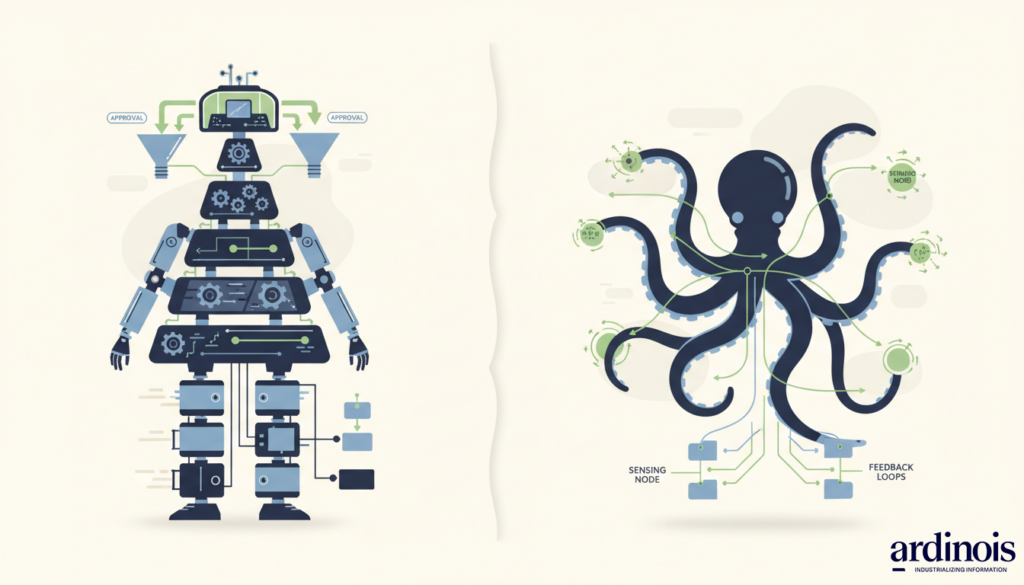
There is a distinction in systems theory that most management teams never encounter, yet it explains why their organisations increasingly feel unmanageable.
The distinction is between complicated and complex.
A jet engine is complicated. It consists of thousands of precisely engineered components, requires specialised expertise to assemble, and demands rigorous quality control. Yet its behaviour is fully knowable. Each input produces a predictable output. When something breaks, the root cause can be identified and fixed. The engine behaves the same way in Singapore as it does in Seattle.
For decades, organisations were designed as if they were jet engines.
Hierarchies coordinated activity. Processes standardised execution. Planning cycles predicted outcomes.Control systems detected deviations and triggered corrections.
This design assumed that, with enough analysis, the right answer could be found and implemented.
For a long time, this assumption held. It built the industrial economy, scaled global supply chains, and enabled consistent quality across continents. The machine metaphor was not symbolic; it was an operating principle that delivered results.
That operating principle no longer fits the operating environment.
From complicated to complex
The world has shifted from complicated to complex.
Complex systems behave differently. Small changes produce disproportionate effects. Causes and consequences are separated by time and distance. Patterns emerge that no one designed. What worked yesterday may fail tomorrow for reasons that only become clear in retrospect.
Consider how information now flows through a typical enterprise. A customer complaint on social media triggers a response from marketing, which conflicts with customer service, contradicts what sales promised, and diverges from product intent. By the time senior leadership becomes aware, the issue has already shaped perception, influenced behaviour, and created internal confusion about ownership and response.
No amount of process optimisation resolves this. The problem is not non-compliance.
The problem is that the procedures assume a stable relationship between action and outcome that no longer exists.
The Tin Man organisation
Organisations designed for complicated problems share recognisable traits.
Decision-making concentrates at the top.
Information flows upward through reporting layers, condensed at each step. Strategy is formulated periodically, cascaded downward, and monitored against targets.
This architecture produces control.
It does not produce adaptability.
This design can be described as the Tin Man organisation: rigid, slow to move, capable of executing instructions but poorly equipped to sense and respond to change.
The symptoms are familiar. Executives describe organisations that are too slow, too cumbersome, unable to reallocate resources when conditions shift. Matrix structures create bottlenecks. Transformation initiatives proliferate while outcomes remain elusive. Research suggests that only a small fraction of large-scale transformations deliver sustained performance gains.
The typical response makes matters worse; More programmes. More coordination layers. More governance committees.
Each intervention increases internal complexity while reducing external adaptability. The organisation becomes simultaneously more controlled and less capable.
The octopus principle
Nature offers a different design.
An octopus has roughly five hundred million neurons, comparable to a dog. Yet more than half are distributed throughout its arms. Each arm can sense, decide, and act without waiting for central instruction. When the octopus moves, it does not issue detailed commands. It establishes intent. The arms adapt locally.
This is distributed intelligence.
Autonomy and coordination coexist.
Information flows in all directions.
Learning happens everywhere.
Organisations designed on this principle behave differently.
Meetings exist to produce decisions, not alignment theatre.
Strategy emerges from those closest to customers and operations.
Innovation occurs throughout the system, not in isolated labs.
The contrast is visible at the front line.
In a Tin Man call centre, agents follow scripts and optimise volume.
In an octopus organisation, agents own customer problems, exercise judgement, and contribute to systemic improvement.
The difference is not in empowerment claims but in learning built into the system.
Behaviour follows design
The shift from Tin Man to octopus is often framed as cultural. I don’t buy that statement. It is behavioural — and behaviour follows design.
Three categories of behaviour keep organisations trapped.
- Loss of clarity.
Strategies remain abstract. Context degrades as information moves upward and people act without understanding why decisions matter. - Erosion of ownership.
People are managed as resources rather than contributors. Learning is stimulated in this environment as failure produces blame and risk is suppressed through compliance. - Suppression of curiosity.
Systems reward predictability while claiming to value innovation. This is contradictory, as exploration becomes risky and will be avoided.
One could say that these are leadership failures. This is partly true, as they are design outcomes and designs happens to come from leadership.
A structure optimised for control produces controlled behaviour.
A structure optimised for adaptation produces adaptive behaviour.
How the shift actually happens
Organisations that move from Tin Man to octopus describe the transition as emergent, not imposed.
Three principles recur.
Change with people, not to them.
Solutions must be discovered by those closest to the work. Intelligence does not cascade; it accumulates locally. Start working with operating teams and understand their challenges.
Entwine learning with impact.
Every initiative must produce value or insight. Learning that does not inform action is noise.
Do less to achieve more.
Progress comes from removing constraints, not adding layers. Dependencies, approvals, and rituals that no longer serve the system must disappear.
Smaller moves, executed continuously, outperform grand transformations.
What this enables
Some organisations have redesigned themselves accordingly.
Haier replaced hierarchy with thousands of self-managed microenterprises.
Bayer eliminated most middle-management layers and shortened decision cycles.
Repsol reduced hundreds of initiatives to a handful of strategic priorities and staffed them fully.
They are organisational strategies that allow technology to compound.These are not technology strategies.
The inverse is also true. Where adaptive capacity is absent, innovation stalls. Pilots remain pilots. Insights remain presentations. The technology works; the organisation cannot absorb it.
Design for uncertainty
The choice between Tin Man and octopus is ultimately a choice about uncertainty.
Tin Man organisations attempt to eliminate uncertainty through analysis and control. This works in complicated environments.
Octopus organisations accept uncertainty as permanent. They navigate it through sensing, responding, and learning.
The environment has shifted. Organisations designed for a complicated world now operate in a complex one. The mismatch explains why transformation stalls, why AI initiatives fail to scale, and why strategic intent rarely translates into operational reality.
The response is not more transformation. It requires a different design.
For us, this is not a future vision. It already distinguishes organisations that adapt from those that seize.
The question for leadership teams is which design principle currently governs their organisation — and whether it matches the world they operate in.